Every page in World's Smokers to Color Volume Two began as a real piece of historical art. Here are 23 of them: the original on the left, our coloring page on the right, and the story behind each one.
Get the book: World's Smokers to Color Volume Two
“Seydlitz Cuirassier”

From the 1888 Allen & Ginter “World’s Smokers” cigarette cards: “Seydlitz Cuirassier.”
The card is likely named for Friedrich Wilhelm von Seydlitz, one of Frederick the Great’s most celebrated Prussian cavalry generals. Seydlitz was a pipe smoker with a famous battlefield habit: throwing down his lit pipe was his signal to launch a cavalry charge.
Get this book: World's Smokers to Color Volume Two →
“Bavarian Hunter”
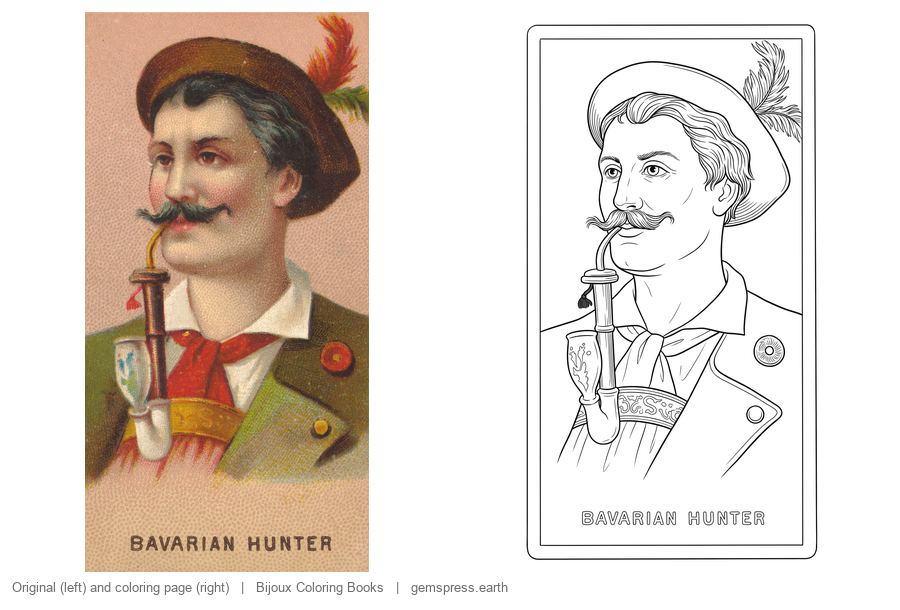
From the 1888 Allen & Ginter “World’s Smokers” cigarette cards: “Bavarian Hunter.”
Get this book: World's Smokers to Color Volume Two →
“Russian Lady”
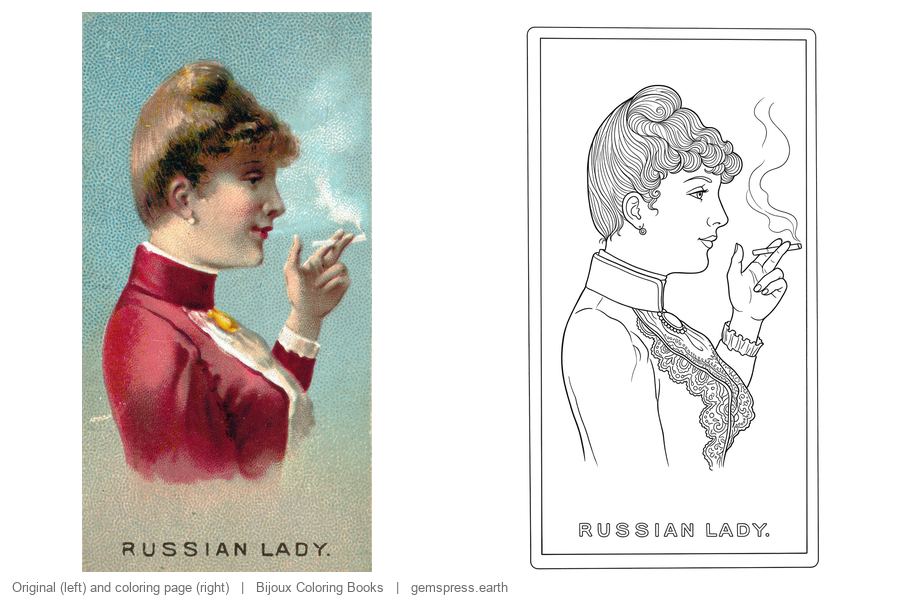
From the 1888 Allen & Ginter “World’s Smokers” cigarette cards: “Russian Lady.”
The high, structured collar and lace trim reflect fashionable 1880s women’s dress across much of Europe and America. It was a time when cigarette smoking by women was still controversial, but was beginning to be shown, as here, as a mark of urban sophistication.
Free to print: this page is in our free Sampler Pack. Get the free pages.
Get this book: World's Smokers to Color Volume Two →
“Asiatic Turk”
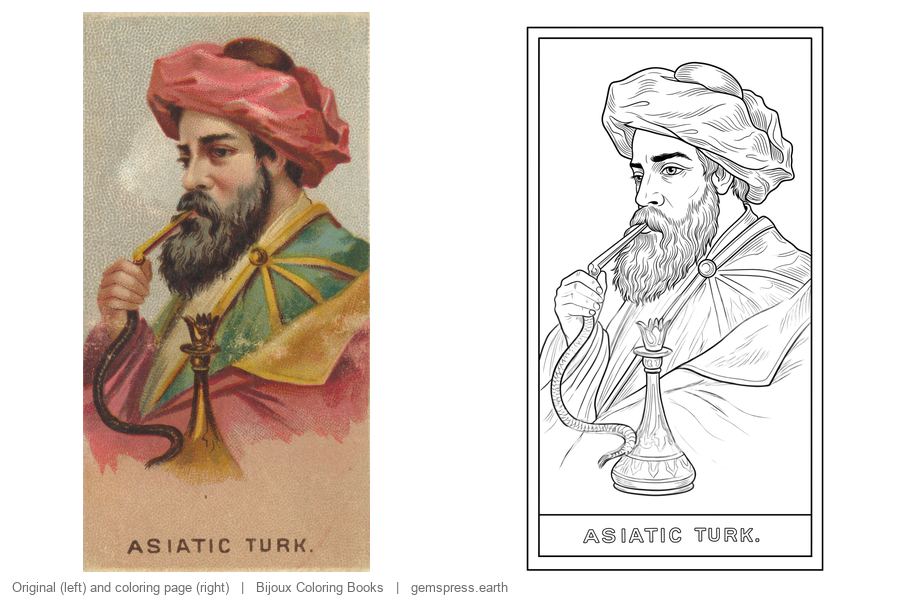
From the 1888 Allen & Ginter “World’s Smokers” cigarette cards: “Asiatic Turk.” The vessel shown here is a hookah, a water pipe originally developed in the Indian subcontinent or Persia around the 16th century. It spread widely through the Ottoman Empire, and it remains a central fixture of social smoking across the Middle East today.
Get this book: World's Smokers to Color Volume Two →
“Turkish Officer”
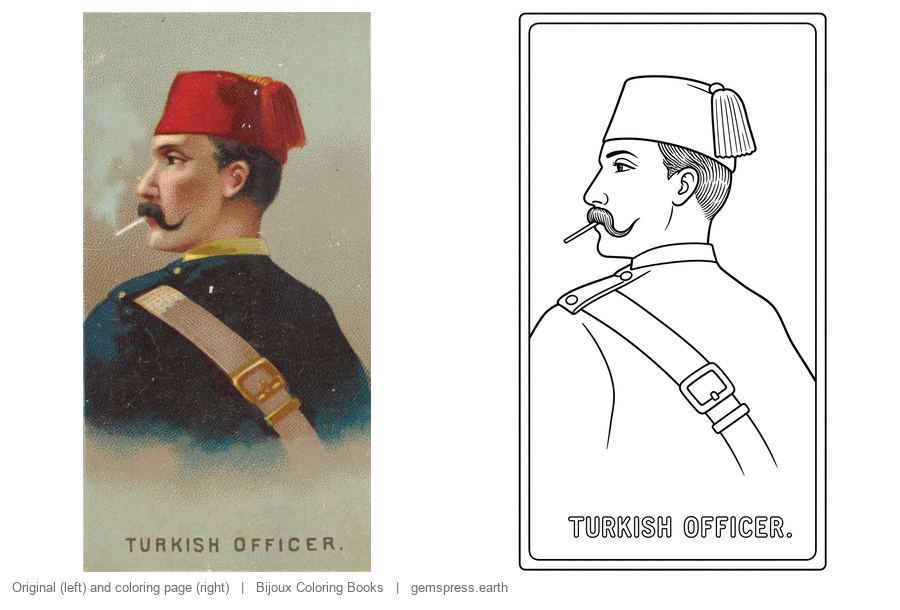
From the 1888 Allen & Ginter “World’s Smokers” cigarette cards: “Turkish Officer.”
The fez he’s wearing, a brimless felt cap, was made standard headwear for Ottoman officials and soldiers as part of a 19th-century reform effort. It was later banned in Turkey by Mustafa Kemal Atatürk in 1925, as part of his push toward Western-style modernization.
Get this book: World's Smokers to Color Volume Two →
“Hungarian”
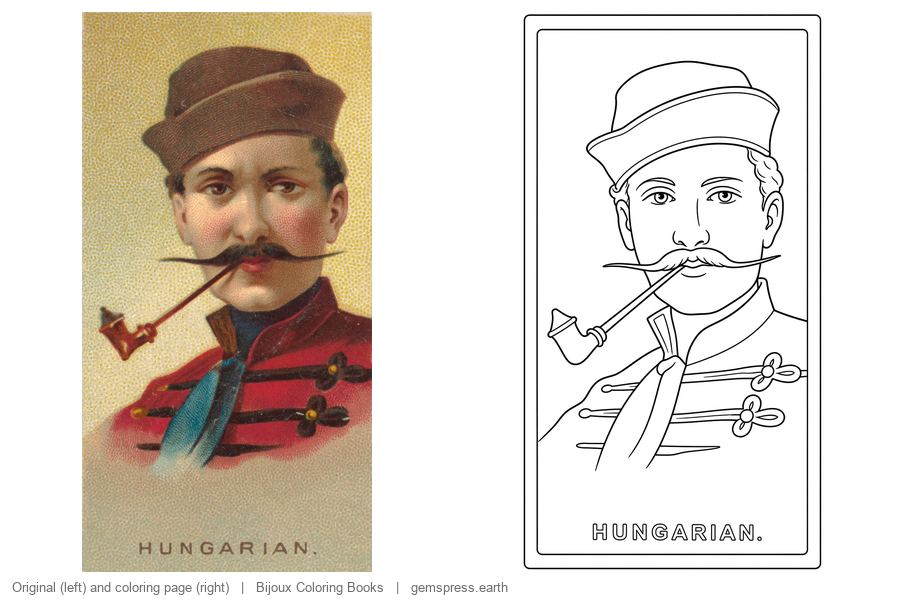
From the 1888 Allen & Ginter “World’s Smokers” cigarette cards: “Hungarian.”
His braided military-style jacket is a dolman, historically associated with hussar cavalry regiments. Armies across Europe adopted versions of it throughout the 19th century.
Get this book: World's Smokers to Color Volume Two →
“Swede – 30 Years’ War”
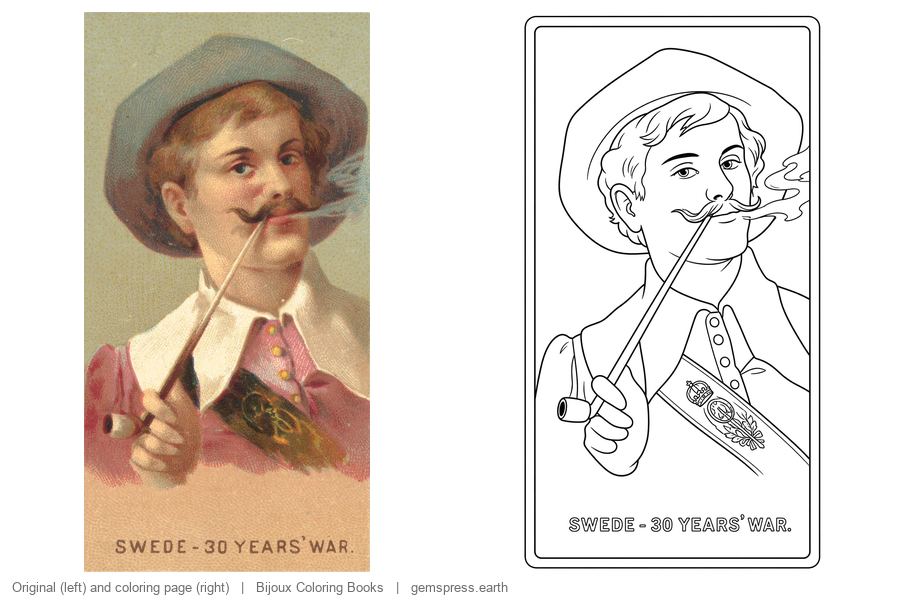
From the 1888 Allen & Ginter “World’s Smokers” cigarette cards: “Swede – 30 Years’ War.” This soldier is from the Thirty Years’ War (1618-1648), a devastating pan-European conflict in which Sweden, under King Gustavus Adolphus, became a major military power and pioneered cavalry and artillery tactics that influenced European warfare for the rest of the century.
Get this book: World's Smokers to Color Volume Two →
“Albanian”
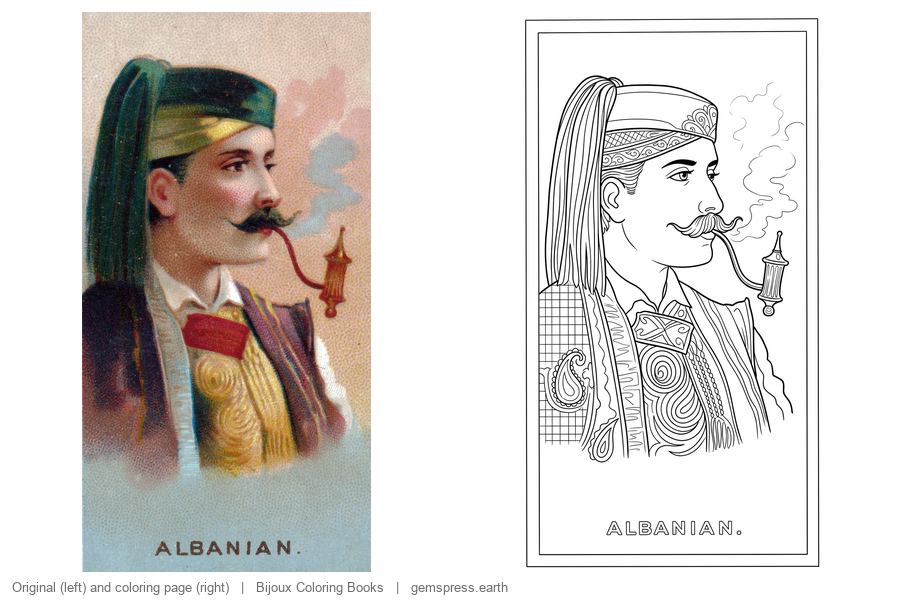
From the 1888 Allen & Ginter “World’s Smokers” cigarette cards: “Albanian.” In 1888 Albania was still part of the Ottoman Empire, and wouldn’t become independent until 1912. The elaborately embroidered vest and turban-style headwrap reflect real regional Balkan dress, shaped by centuries of Ottoman influence.
Get this book: World's Smokers to Color Volume Two →
“Amer. Indian”

From the 1888 Allen & Ginter “World’s Smokers” cigarette cards: “Amer. Indian.” This card reflects the Victorian trading-card fascination with Indigenous American subjects.
Get this book: World's Smokers to Color Volume Two →
“Austrian Soldier”
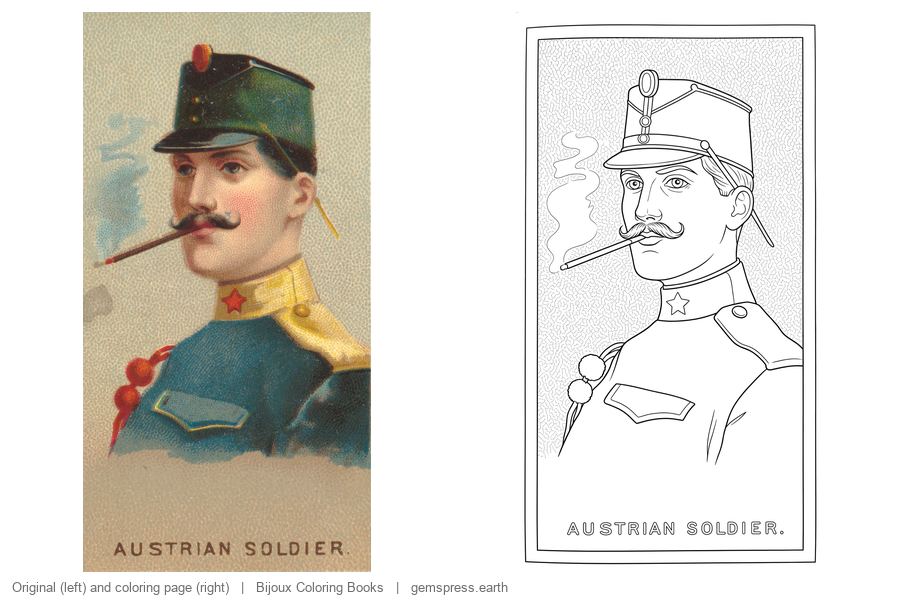
From the 1888 Allen & Ginter “World’s Smokers” cigarette cards: “Austrian Soldier.” The peakless kepi-style cap and single-breasted tunic reflect standard Austro-Hungarian army uniform of the 1880s.
Get this book: World's Smokers to Color Volume Two →
“Bedouin”
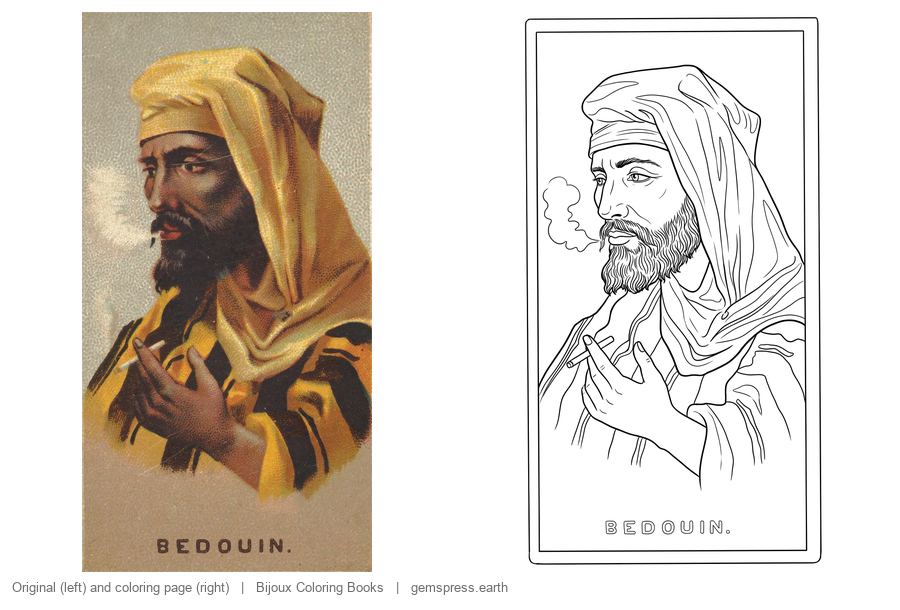
From the 1888 Allen & Ginter “World’s Smokers” cigarette cards: “Bedouin.” Bedouin communities are traditionally nomadic Arab peoples of the deserts of the Middle East and North Africa, historically organized around herding and long-distance trade routes. It’s a way of life that predates, and long outlasted, the empires that rose and fell around it.
Get this book: World's Smokers to Color Volume Two →
“Bulgarian”
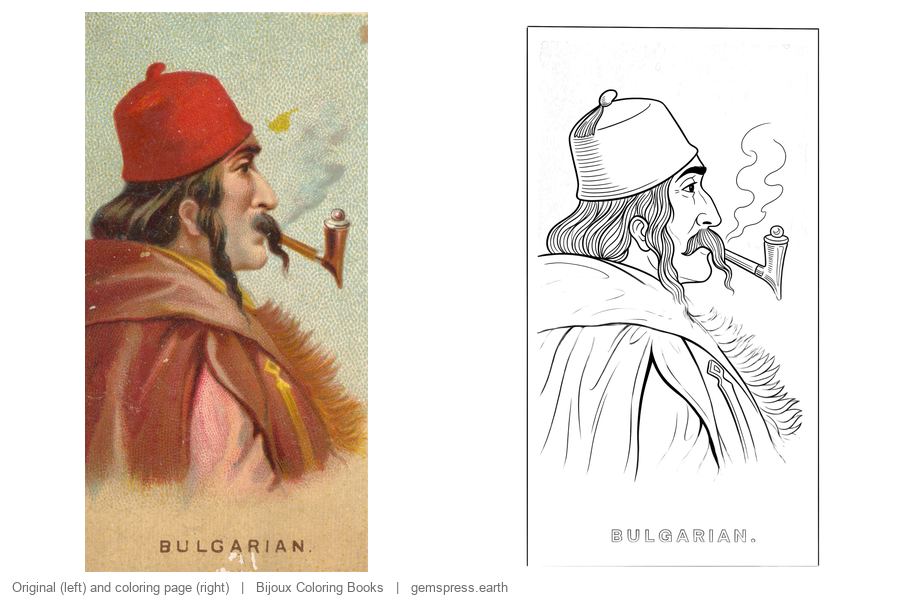
From the 1888 Allen & Ginter “World’s Smokers” cigarette cards: “Bulgarian.” Bulgaria had only become a self-governing principality in 1878, a decade before this card was printed, after nearly five centuries of Ottoman rule.
Get this book: World's Smokers to Color Volume Two →
“Circassian”

From the 1888 Allen & Ginter “World’s Smokers” cigarette cards: “Circassian.” The Circassians are a people originally from the North Caucasus. After the Russian conquest of the region, they suffered a mass forced expulsion in the 1860s. By the time this card was printed, Circassian communities had been resettled across the Ottoman Empire for barely two decades.
Get this book: World's Smokers to Color Volume Two →
“Cossack”

From the 1888 Allen & Ginter “World’s Smokers” cigarette cards: “Cossack.” Cossacks were historically semi-autonomous, self-governing military communities on the steppes of Ukraine and southern Russia, famous for their horsemanship. They served the Russian Empire as elite cavalry, in exchange for a significant degree of local self-rule.
Get this book: World's Smokers to Color Volume Two →
“English Naval Officer”
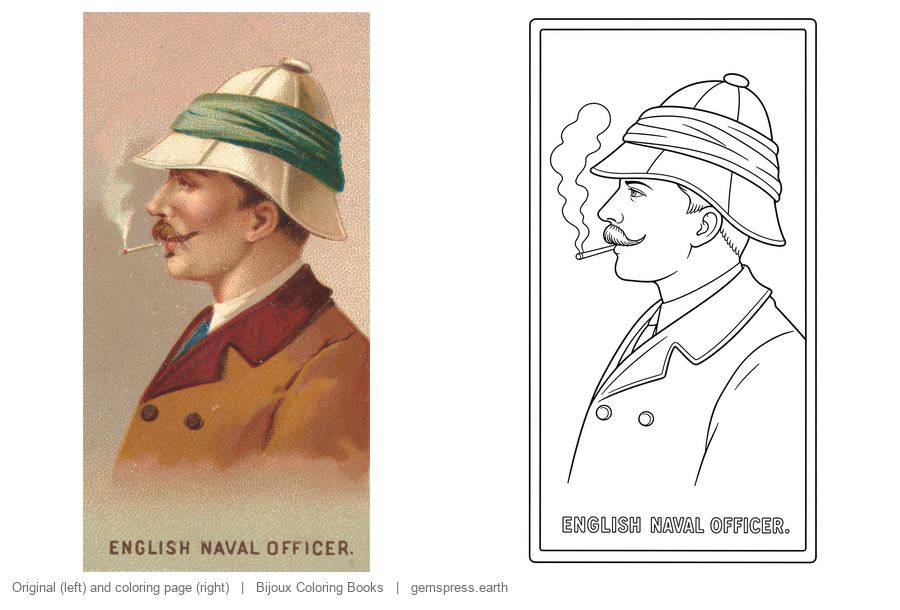
From the 1888 Allen & Ginter “World’s Smokers” cigarette cards: “English Naval Officer.” The pith helmet was standard-issue tropical headgear for British colonial military and naval officers by the 1880s. Its lightweight cork or pith construction was designed to protect against the sun in Britain’s overseas territories.
Get this book: World's Smokers to Color Volume Two →
“Soldier, French Revolution”

From the 1888 Allen & Ginter “World’s Smokers” cigarette cards: “Soldier, French Revolution.” The bicorne hat and epaulette reflect French military dress of the 1790s, roughly a century before this card was printed.
Get this book: World's Smokers to Color Volume Two →
“Greek”

From the 1888 Allen & Ginter “World’s Smokers” cigarette cards: “Greek.” Greece had won full independence from the Ottoman Empire only in 1830, less than sixty years before this card was issued. Like several other cards in this set, “Greek” represented a still fairly young modern national identity to an 1888 audience.
Get this book: World's Smokers to Color Volume Two →
“Morocco”
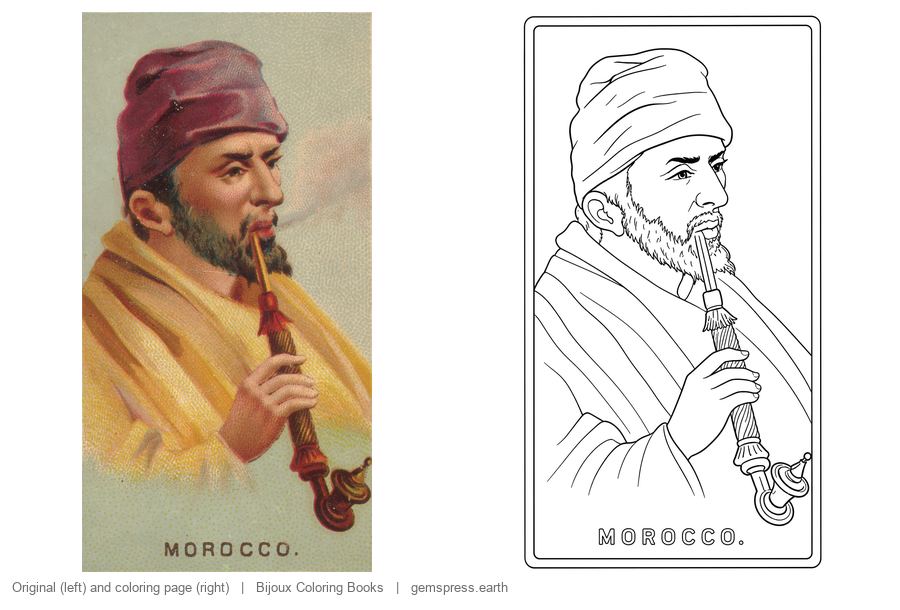
From the 1888 Allen & Ginter “World’s Smokers” cigarette cards: “Morocco.” In 1888 Morocco was one of the few North African states never absorbed into the Ottoman Empire. It kept its independence under its own sultanate, and didn’t come under European colonial control (split between France and Spain) until a protectorate was imposed in 1912.
Get this book: World's Smokers to Color Volume Two →
“Old Planter”
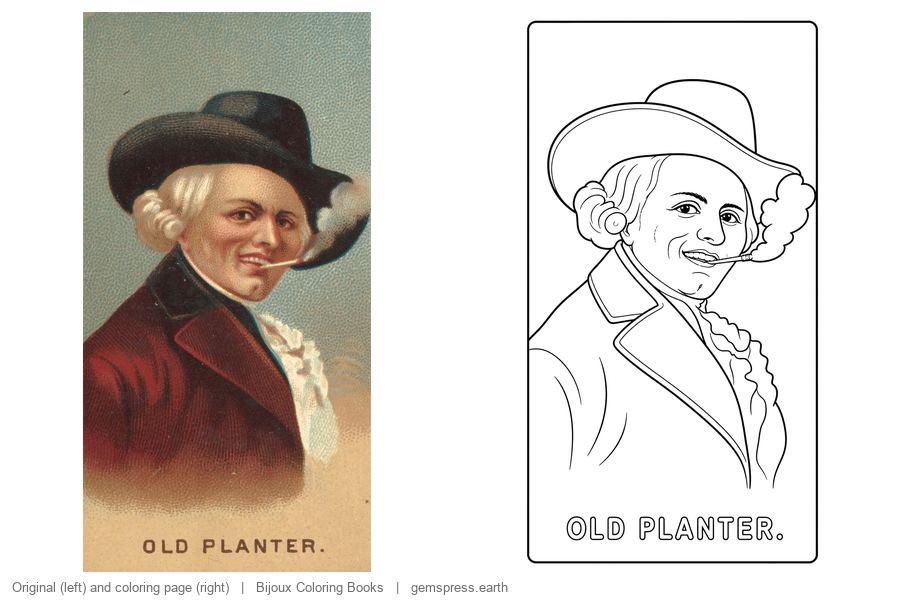
From the 1888 Allen & Ginter “World’s Smokers” cigarette cards: “Old Planter.” “Planter” was 19th-century terminology for the owner or manager of a large agricultural estate, most associated in American usage with the plantation economy of the antebellum South. That was a system built on enslaved labor, abolished only about twenty years before this card was printed. Allen & Ginter was a Virginia company, and this was a very recent past.
Get this book: World's Smokers to Color Volume Two →
“Persian”
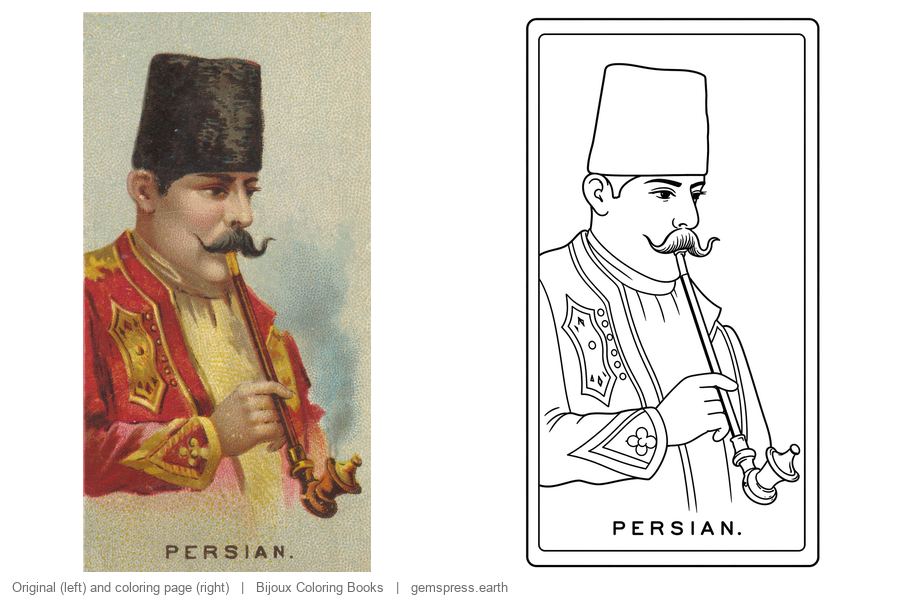
From the 1888 Allen & Ginter “World’s Smokers” cigarette cards: “Persian.” His tall felt hat resembles a traditional Qajar-era Persian style. Iran (called Persia by Western sources until the 1930s) was ruled in 1888 by the Qajar dynasty, a monarchy that lasted from the late 18th century until 1925.
Get this book: World's Smokers to Color Volume Two →
“Prussian Lieutenant”
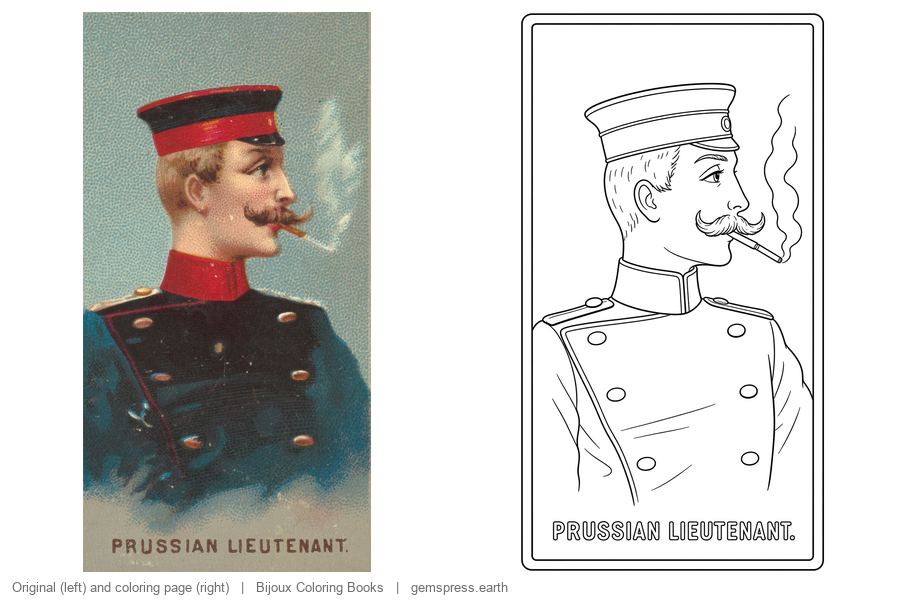
From the 1888 Allen & Ginter “World’s Smokers” cigarette cards: “Prussian Lieutenant.” By 1888, Prussia hadn’t been a fully independent state for seventeen years. It became the dominant founding member of the unified German Empire in 1871, but “Prussian” remained a widely used shorthand for German military identity throughout this era.
Get this book: World's Smokers to Color Volume Two →
“Servian”
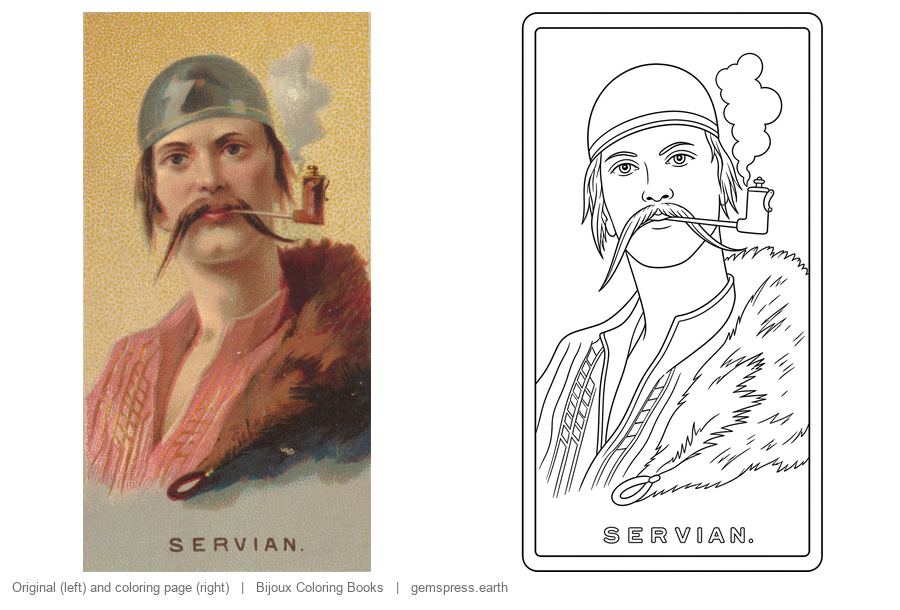
From the 1888 Allen & Ginter “World’s Smokers” cigarette cards: “Servian” — an older English spelling of Serbian. Like Bulgaria and Greece elsewhere in this set, Serbia had only achieved full independence from the Ottoman Empire in 1878, a decade before this card was printed.
Get this book: World's Smokers to Color Volume Two →
“Suabian Peasant”

From the 1888 Allen & Ginter “World’s Smokers” cigarette cards: “Suabian Peasant.” “Suabian” is an older spelling of Swabian, from Swabia, a historic region of southwestern Germany with its own distinct dialect and folk traditions. Those traditions still survive regionally, long after German unification absorbed Swabia into the modern nation.
Get this book: World's Smokers to Color Volume Two →
Want to try before you buy? Print free sample pages at gemspress.earth/free-coloring-pages.