Every page in Weird Tales to Color Volume One began as a real piece of historical art. Here are 35 of them: the original on the left, our coloring page on the right, and the story behind each one.
Get the book: Weird Tales to Color Volume One
“The Devil’s Martyr”
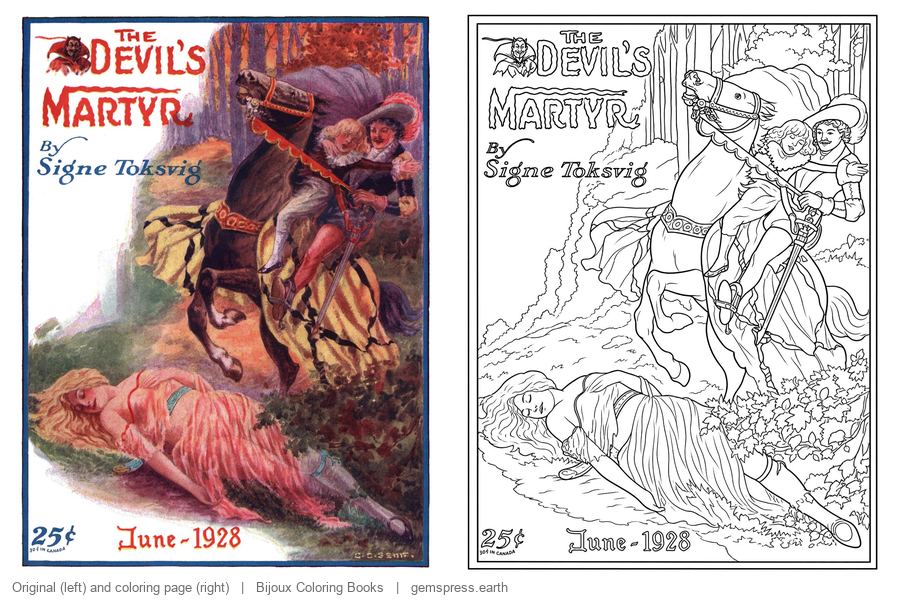
Weird Tales, June 1928. “The Devil’s Martyr” by Signe Toksvig. Toksvig was a Danish-American writer and journalist whose career extended well beyond pulp horror. The cover is by C. C. Senf, who, according to his colleagues’ later account, eventually stopped reading the stories before illustrating their covers, with occasionally strange results.
Free to print: this page is in our free Sampler Pack. Get the free pages.
Get this book: Weird Tales to Color Volume One →
“The Foot Fetish”
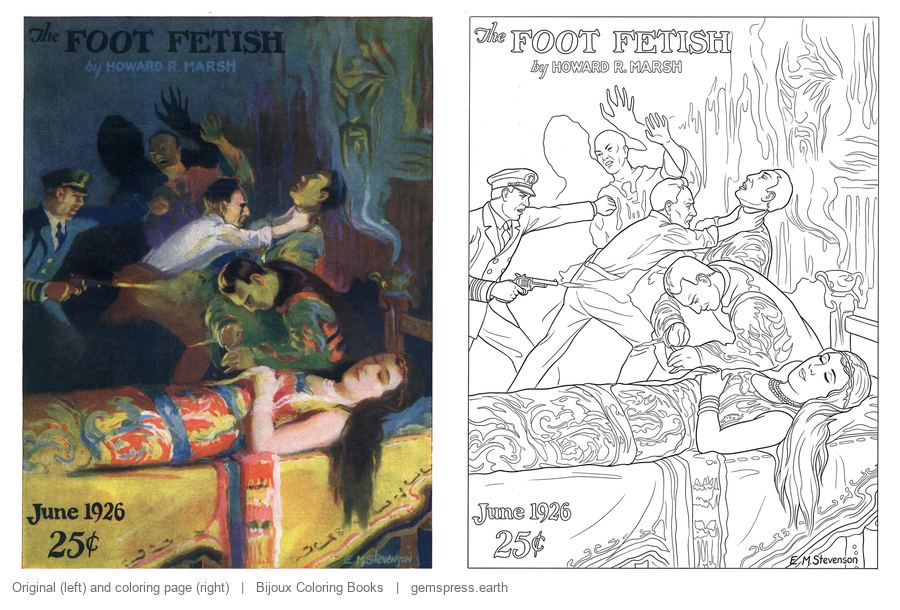
Weird Tales, June 1926. “The Foot Fetish” by Howard R. Marsh.
“Fetish” here means its older anthropological sense: an object believed to hold magical power.
The cover is by E. M. Stevenson, one of only five he painted for Weird Tales, all in the mid-1920s. It shows a naval officer firing a revolver, a strangling in progress, and a man hovering over a sleeping woman.
Get this book: Weird Tales to Color Volume One →
“The Witches’ Sabbath”
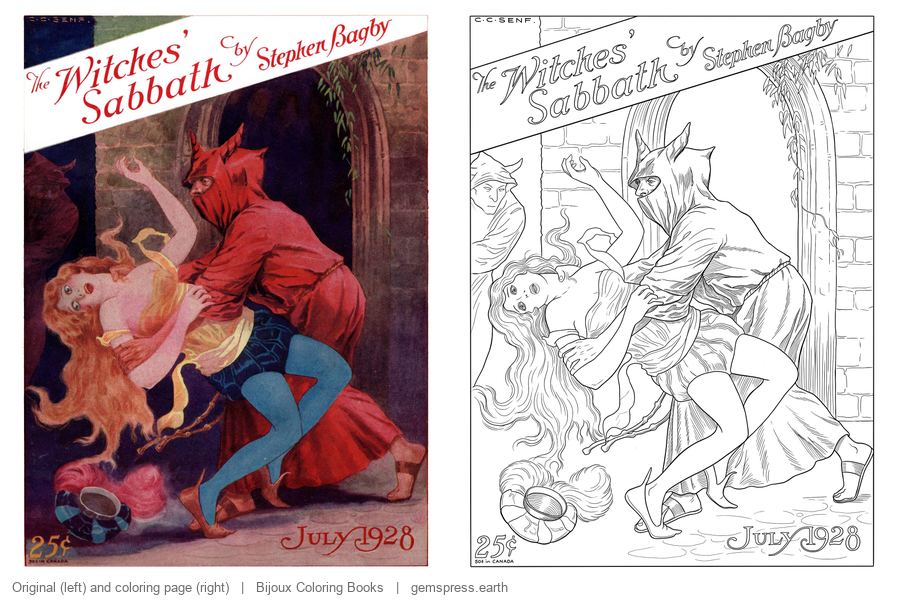
Weird Tales, July 1928. “The Witches’ Sabbath” by Stephen Bagby, cover by C. C. Senf. Witch-trial and witches’-sabbath imagery was a Weird Tales staple throughout the 1920s, drawing on the old fascination with the Salem trials and the European witch panics.
Get this book: Weird Tales to Color Volume One →
“The Werewolf’s Daughter”
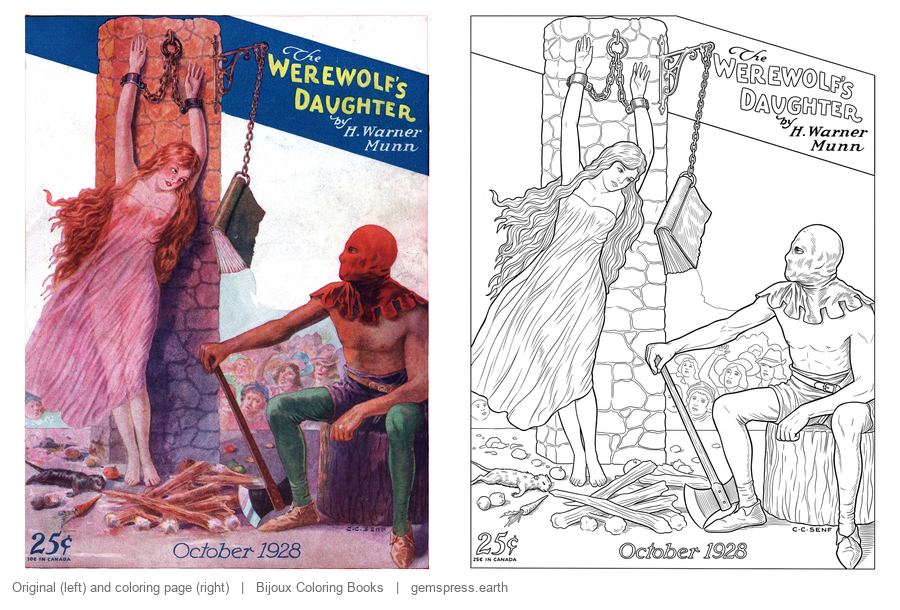
Weird Tales, October 1928. “The Werewolf’s Daughter” by H. Warner Munn. Munn got his start after H. P. Lovecraft, in the magazine’s letter column, publicly wished someone would write a story from the werewolf’s own point of view. Munn obliged. Cover by C. C. Senf.
Get this book: Weird Tales to Color Volume One →
“The Bat-Men of Thorium”
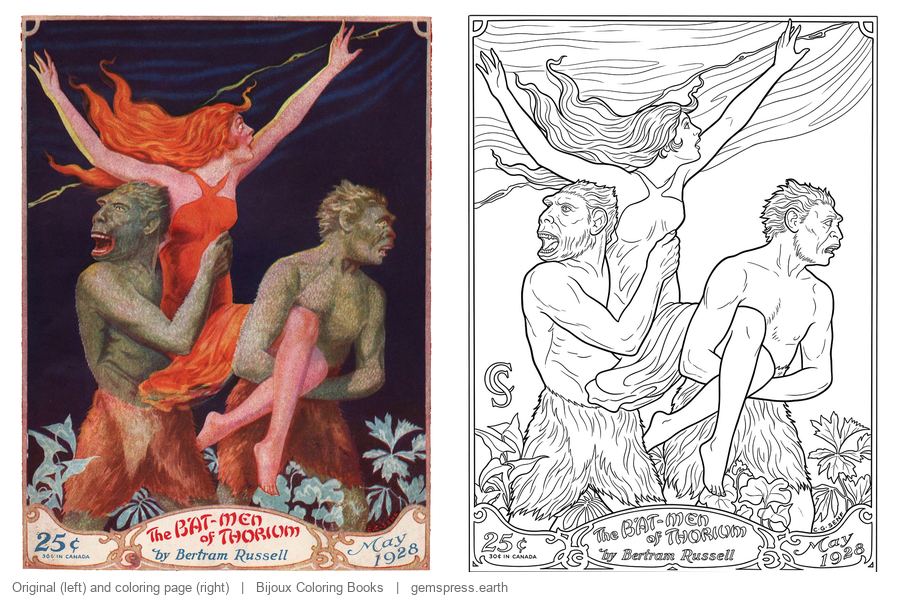
Weird Tales, May 1928. “The Bat-Men of Thorium” by Bertram Russell (L. H. Hardingham). Covery by C. C. Senf.
Get this book: Weird Tales to Color Volume One →
“The Dark Lore”
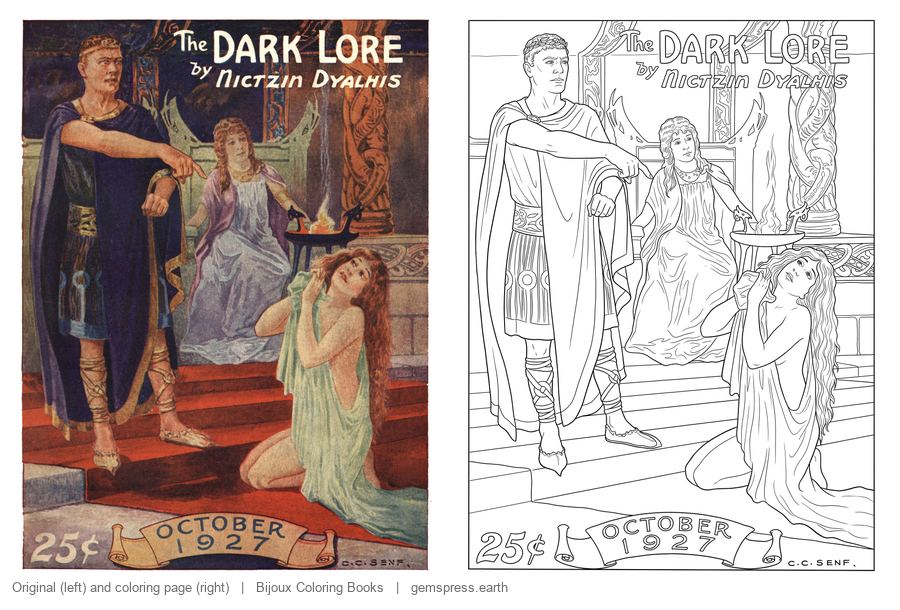
Weird Tales, October 1927. “The Dark Lore” by Nictzin Dyalhis. Cover by C. C. Senf, whom H. P. Lovecraft privately complained “has no sense of the fantastic whatever” in a 1927 letter.
Get this book: Weird Tales to Color Volume One →
“The Whispering Thing”
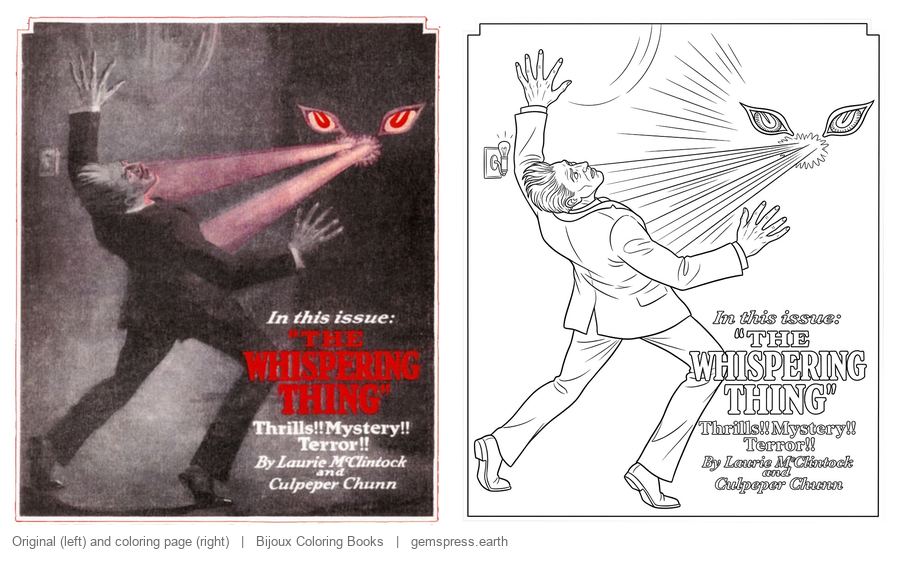
Weird Tales, April 1923. “The Whispering Thing” by Laurie McClintock and Culpeper Chunn. The cover was drawn by R. M. Mally, a mysterious artist whose real identity is still debated. Pulp historian David Saunders traced the initials to a George William Mally, but the seal beneath the signature carries his wife Ruth’s initials. So she may have been the artist, or the two may have worked together.
Get this book: Weird Tales to Color Volume One →
“Sunfire”
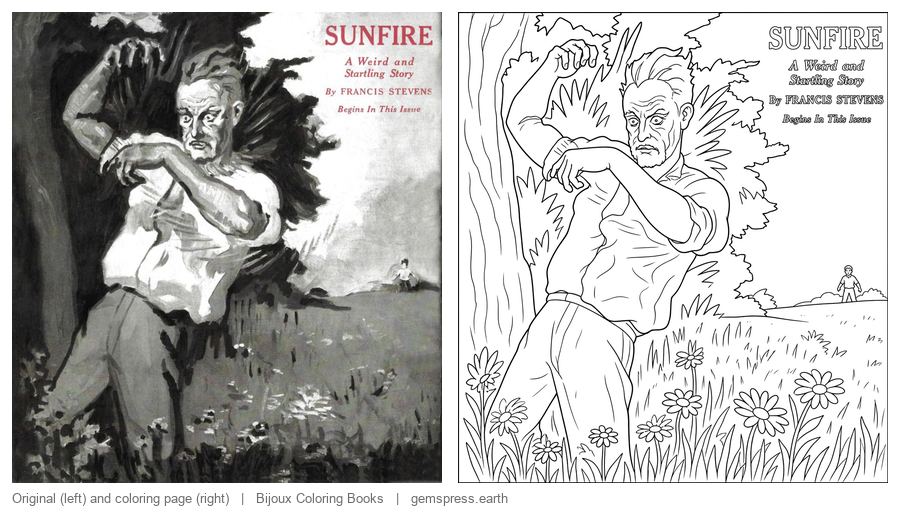
Weird Tales, July-August 1923. “Sunfire” by Francis Stevens. “A Weird and Startling Story.” Cover by R. M. Mally.
“Francis Stevens” was the pen name of Gertrude Barrows Bennett, one of the first great American women writers of fantasy and science fiction. And, poignantly, this was the very last story of her writing career.
Get this book: Weird Tales to Color Volume One →
“The Woman with the Velvet Collar”
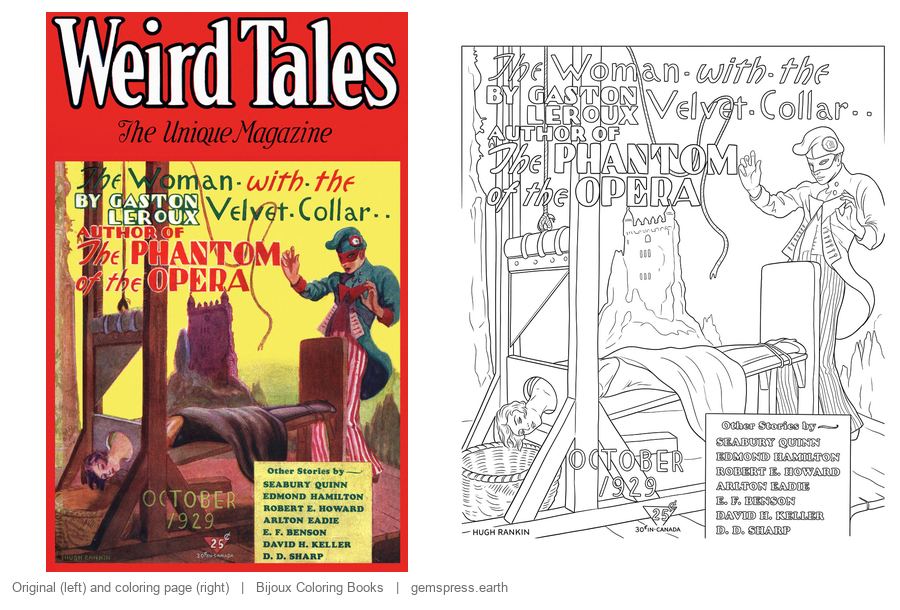
Weird Tales, October 1929. “The Woman with the Velvet Collar” by Gaston Leroux, “Author of The Phantom of the Opera.” Cover by Hugh Rankin.
Leroux was already world-famous for The Phantom of the Opera (1910). Weird Tales frequently ran translated reprints of established European horror writers alongside its American pulp regulars.
Get this book: Weird Tales to Color Volume One →
“The Wolf-Woman”
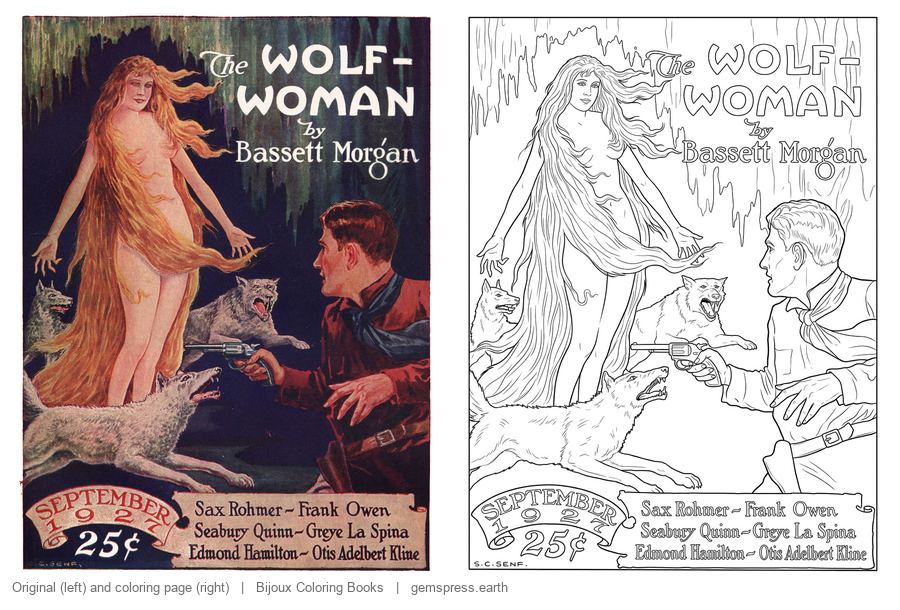
Weird Tales, September 1927. “The Wolf-Woman” by Bassett Morgan, the pen name of Grace Jones, whose stories regularly dealt with body horror and transformation. The cover is by C. C. Senf.
The author has indicated this post may contain content not suitable for all audiences.
Get this book: Weird Tales to Color Volume One →
“Wolfshead”
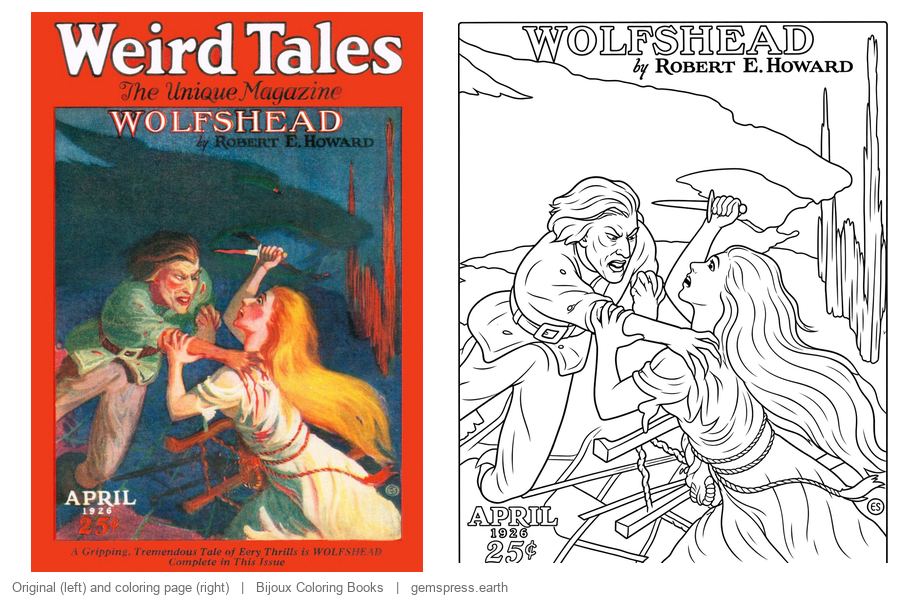
Weird Tales, April 1926. “Wolfshead” by Robert E. Howard. This was one of Howard’s very first professional sales, published when he was twenty, six years before Conan the Barbarian made him famous.
Get this book: Weird Tales to Color Volume One →
“The Master of Doom”
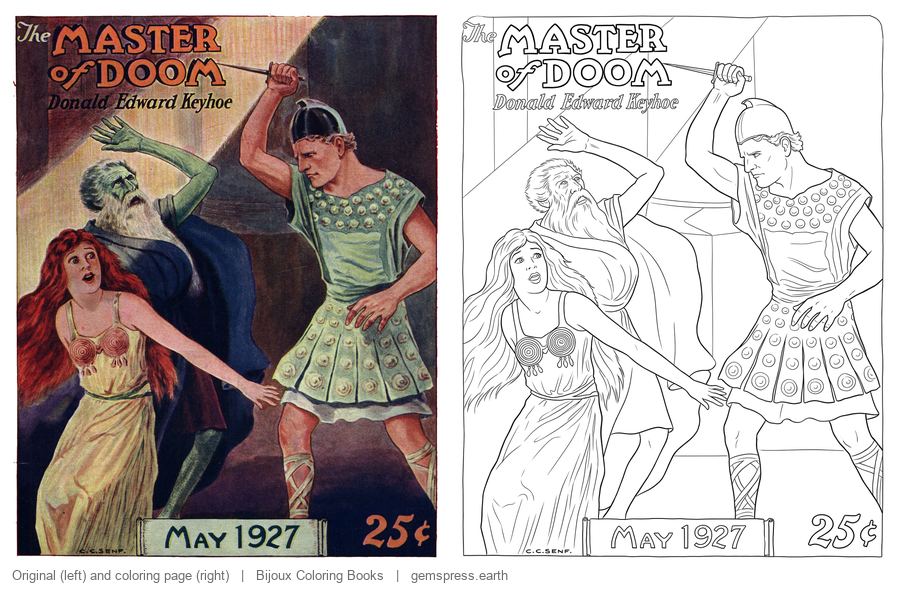
Weird Tales, May 1927. “The Master of Doom” by Donald Edward Keyhoe, whose pulp-writing career came decades before he became one of America’s most famous UFO investigators. The cover is by C. C. Senf.
Get this book: Weird Tales to Color Volume One →
“Red Ether: A Tale of Destruction”
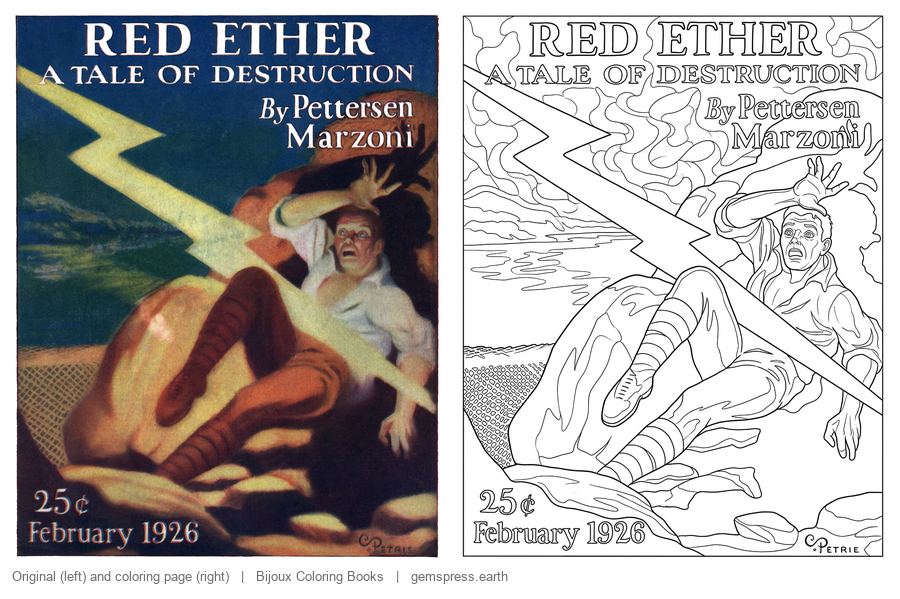
Weird Tales, February 1926. “Red Ether: A Tale of Destruction” by Pettersen Marzoni. Cover by C. Barker Petrie, Jr.
Early Weird Tales leaned hard into “scientific menace” fiction like this: disasters from radiation, strange energies and runaway inventions, years before “science fiction” was a widely used label.
Get this book: Weird Tales to Color Volume One →
“The Evening Wolves” (And Poe’s Ape)
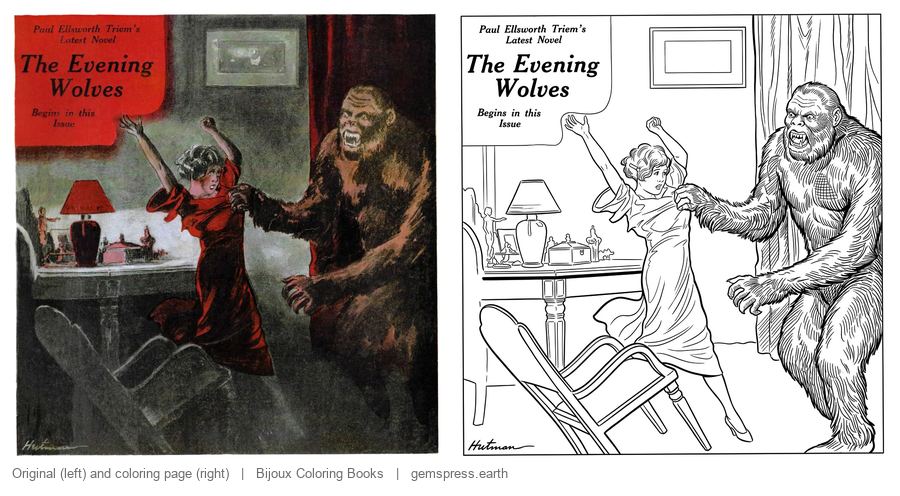
Weird Tales, June 1923. “The Evening Wolves” by Paul Ellsworth Triem. This cover actually illustrates Poe’s “The Murders in the Rue Morgue,” reprinted in the same issue. The artist is William F. Heitman, a rapid-fire Indianapolis newspaper cartoonist.
Get this book: Weird Tales to Color Volume One →
“Invaders from Outside”
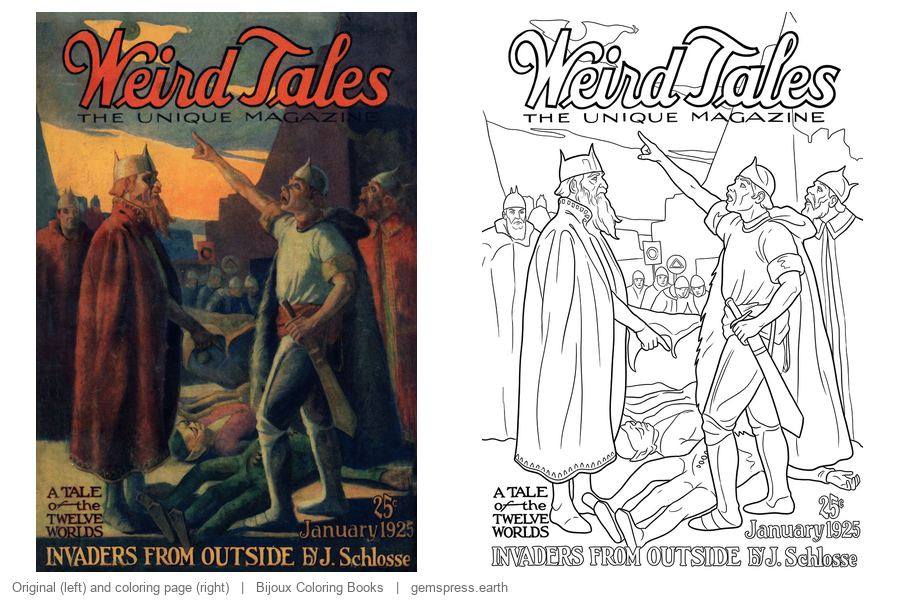
Weird Tales, January 1925. “Invaders from Outside” by J. Schlossel. “A Tale of the Twelve Worlds.”
Schlossel was among the earliest writers to bring full-scale interstellar warfare to American pulp fiction, years before Buck Rogers or Flash Gordon. The cover is by Andrew Brosnatch.
Get this book: Weird Tales to Color Volume One →
“Stealer of Souls”
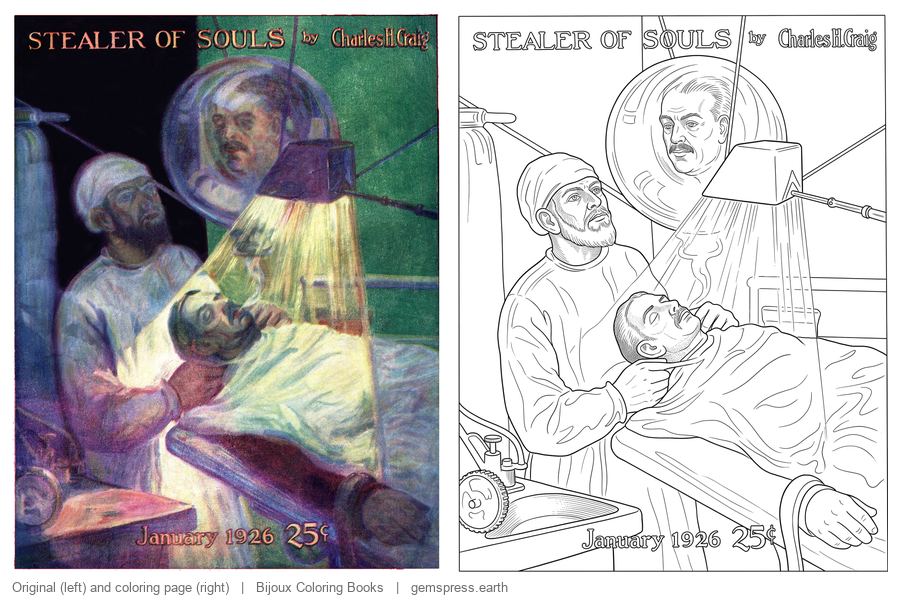
Weird Tales, January 1926. “Stealer of Souls” by Charles H. Craig. Weird Tales printed its authors’ names prominently on the cover, which was unusual for pulps of the era. No artist signature survives clearly on this one, which is credited only to “the artist” in surviving indexes.
Get this book: Weird Tales to Color Volume One →
“The Scourge of B’moth”
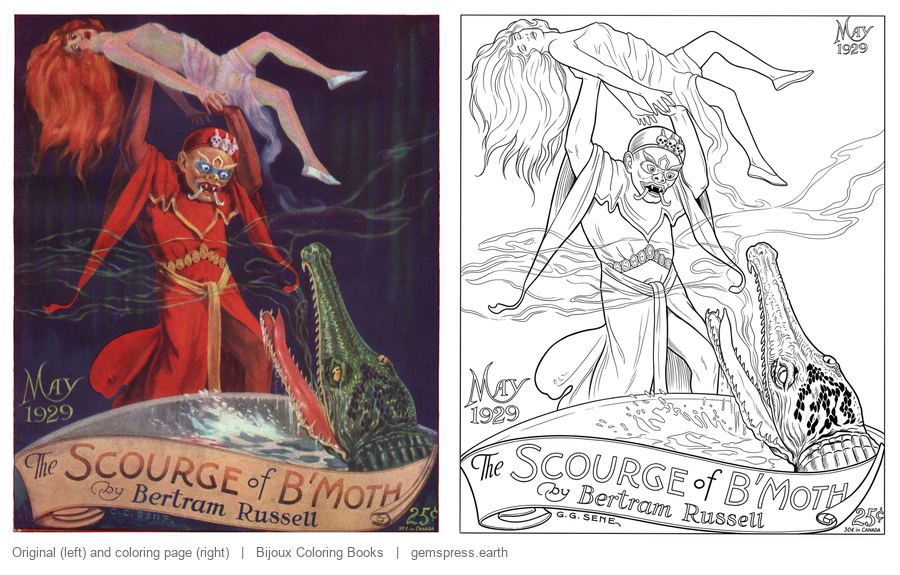
Weird Tales, May 1929. “The Scourge of B’Moth” by Bertram Russell. The cover is by C. C. Senf.
The story’s crocodile-headed god draws on the same well of invented, vaguely Egyptian and Southeast Asian deities that Weird Tales writers built freely from. Accuracy to any real mythology was not the point.
Get this book: Weird Tales to Color Volume One →
“The City of Glass”
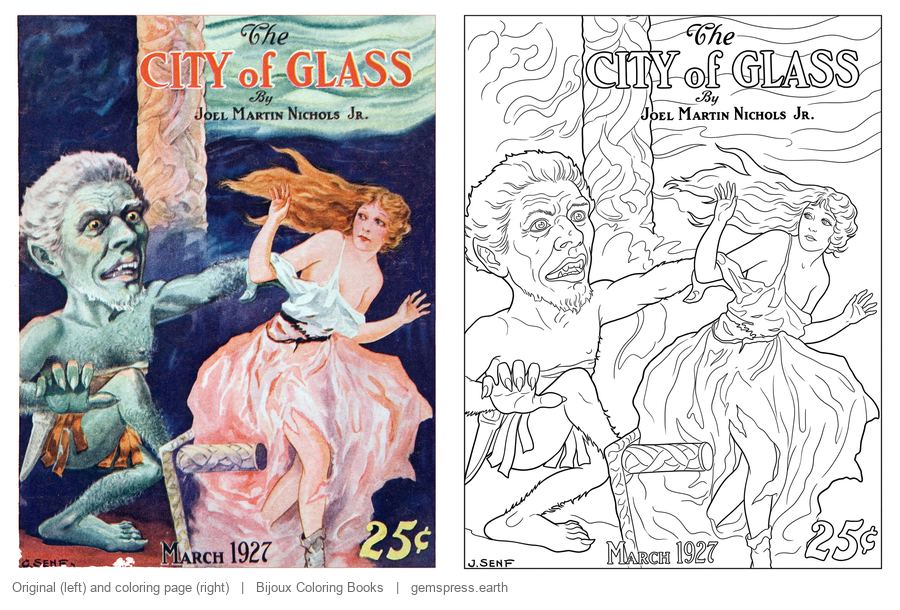
Weird Tales, March 1927. “The City of Glass” by Joel Martin Nichols Jr. “City of Glass” is a recurring title across pulp-era weird fiction. The phrase captured a particular fantasy of impossible, alien architecture that 1920s readers found irresistible.
Get this book: Weird Tales to Color Volume One →
“The Infidel’s Daughter”
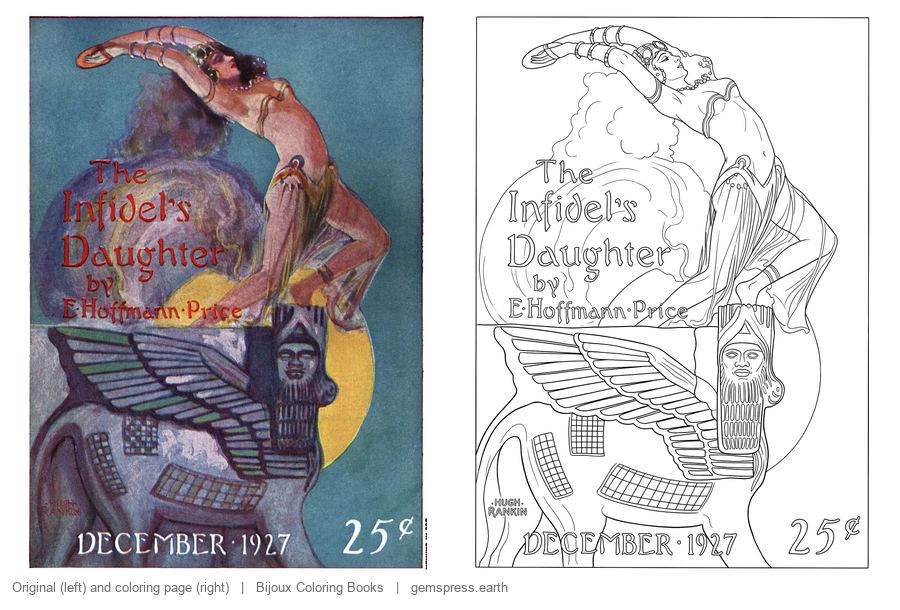
Weird Tales, December 1927. “The Infidel’s Daughter” by E. Hoffmann Price, one of the only Weird Tales writers to actually meet H. P. Lovecraft in person, hosting him at his home in New Orleans. Most of Lovecraft’s famous literary friendships were carried on entirely by letter.
Get this book: Weird Tales to Color Volume One →
“The Woman of the Wood”
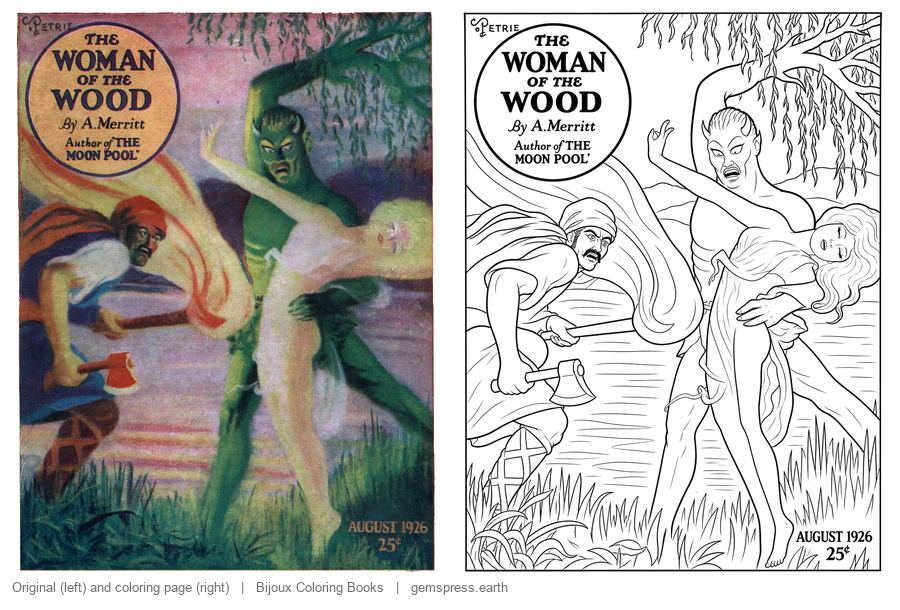
Weird Tales, August 1926. “The Woman of the Wood” by A. Merritt, “Author of The Moon Pool.” A. Merritt was one of the best-paid pulp writers of his era, and this story is still anthologized today as an early classic of ecological horror. The cover is by C. Barker Petrie, Jr.
The author has indicated this post may contain content not suitable for all audiences.
Get this book: Weird Tales to Color Volume One →
“A Suitor from the Shades”
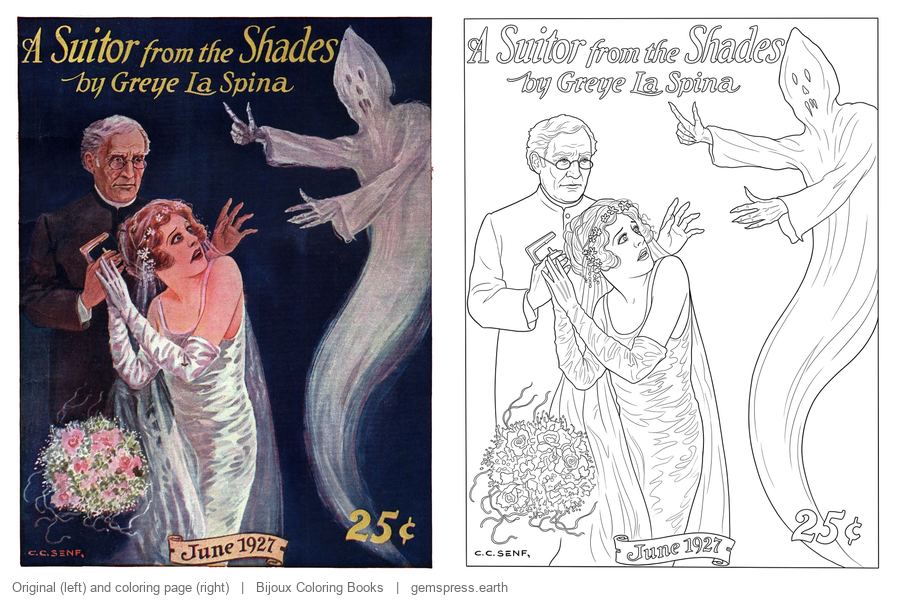
Weird Tales, June 1927. “A Suitor from the Shades” by Greye La Spina., a mainstay of Weird Tales’ early years, and one of relatively few women whose names appeared regularly on its covers in the 1920s. The cover is signed by C. C. Senf, whose day job for most of his career was running his own commercial lithography agency in Chicago.
Get this book: Weird Tales to Color Volume One →
“The Strange People”
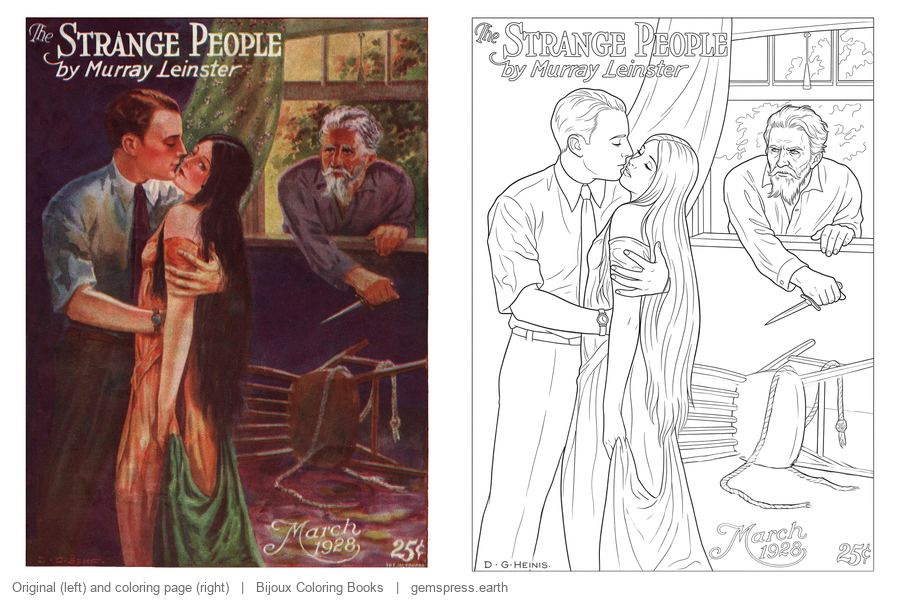
Weird Tales, March 1928. “The Strange People” by Murray Leinster, the pen name of William Fitzgerald Jenkins, later called “the Dean of Science Fiction.” He also patented an early idea resembling hypertext, decades before the internet. The cover is by D. G. Heinis.
Get this book: Weird Tales to Color Volume One →
“The Invading Horde”
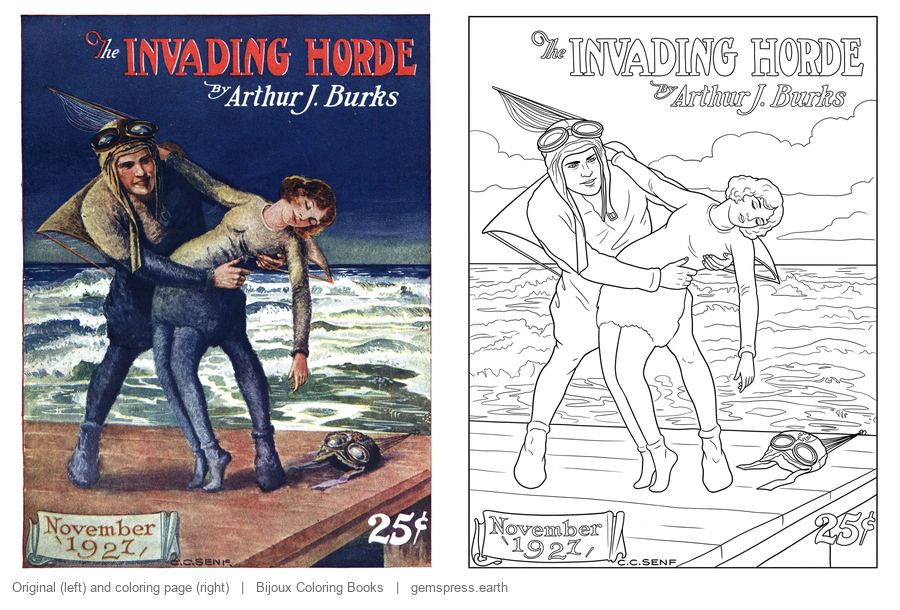
Weird Tales, November 1927. “The Invading Horde” by Arthur J. Burks, who was so prolific that fellow writers nicknamed him “the fiction factory.” The cover is signed by C. C. Senf, at the point in his career when he was contributing both covers and dozens of interior illustrations to nearly every issue.
Get this book: Weird Tales to Color Volume One →
“The Bride of Osiris”
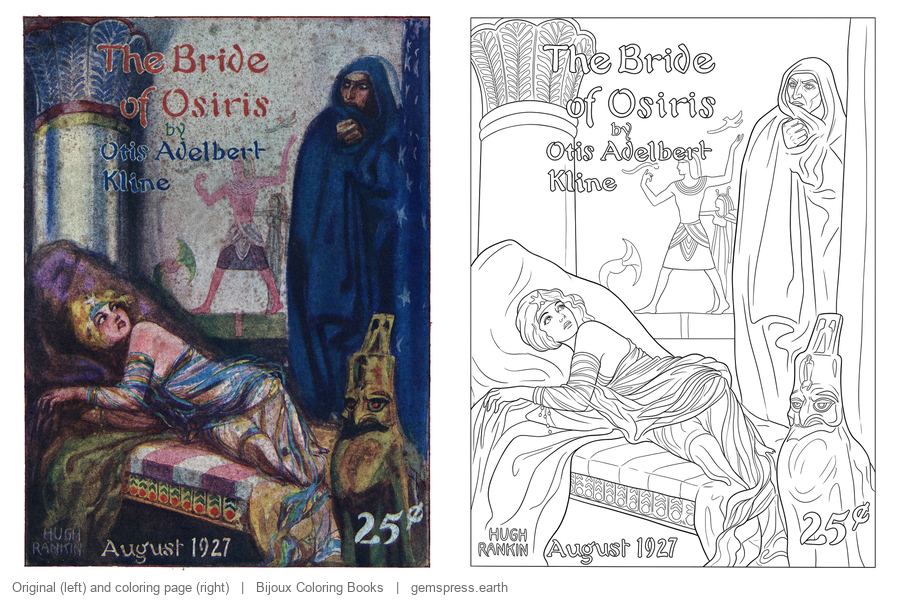
Weird Tales, August 1927. “The Bride of Osiris” by Otis Adelbert Kline, who later became a literary agent, representing other pulp authors, including Robert E. Howard. The cover is by Hugh Rankin, whose mother, the sculptor Ellen Rankin Copp, raised him partly in Munich, where the two studied art together.
Get this book: Weird Tales to Color Volume One →
“Drome”
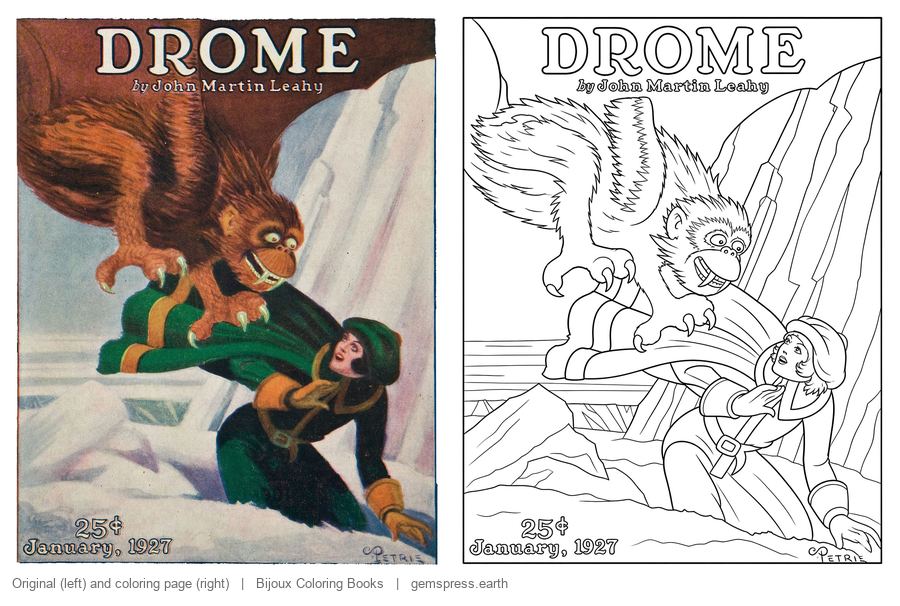
Weird Tales, January 1927. “Drome” by John Martin Leahy. “Drome” belongs to the “hollow earth” branch of pulp adventure, rooted in real 18th- and 19th-century pseudoscience. The cover is by C. Barker Petrie, Jr.
Get this book: Weird Tales to Color Volume One →
“Lochinvar Lodge”
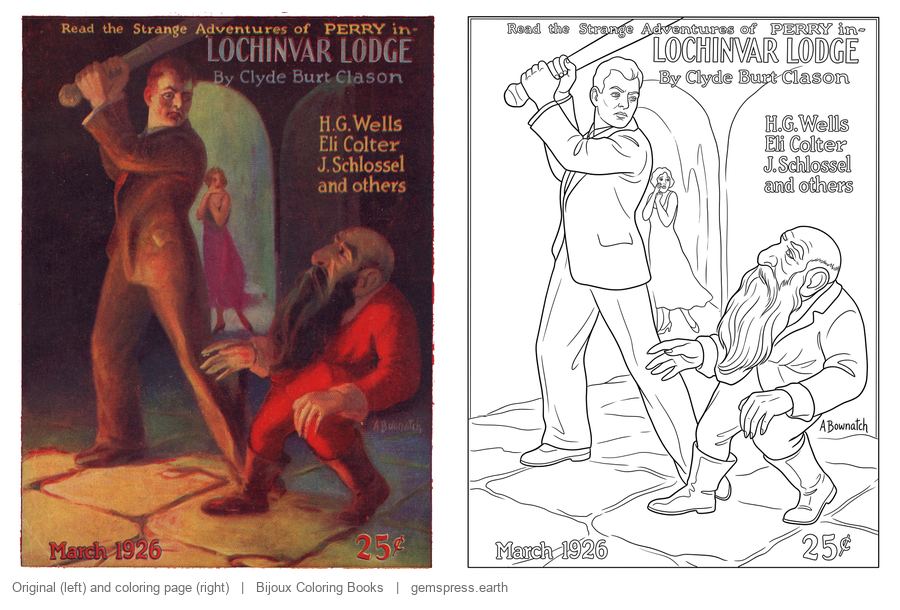
Weird Tales, March 1926. “Read the Strange Adventures of Perry in Lochinvar Lodge,” by Clyde Burt Clason. This issue’s cover also promotes stories by H. G. Wells. Weird Tales regularly reprinted established British authors to lend the young magazine some literary prestige. The cover is by Andrew Brosnatch.
Get this book: Weird Tales to Color Volume One →
“The Supreme Witch”
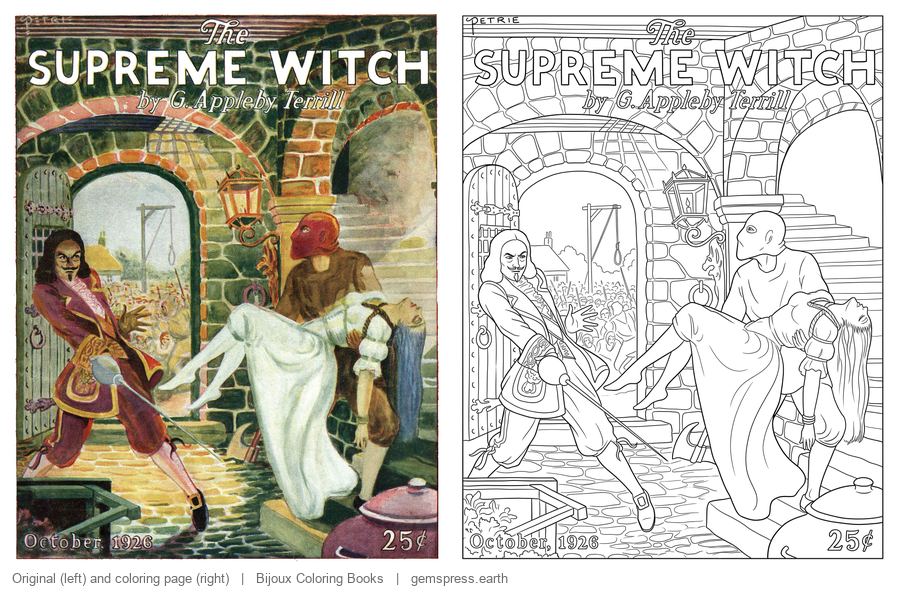
Weird Tales, October 1926. “The Supreme Witch” by G. Appleby Terrill. Executions and witch trials turn up constantly on Weird Tales covers of this decade: real historical persecution needed no invented monster. The cover is by C. Barker Petrie, Jr.
Get this book: Weird Tales to Color Volume One →
“Explorers Into Infinity”
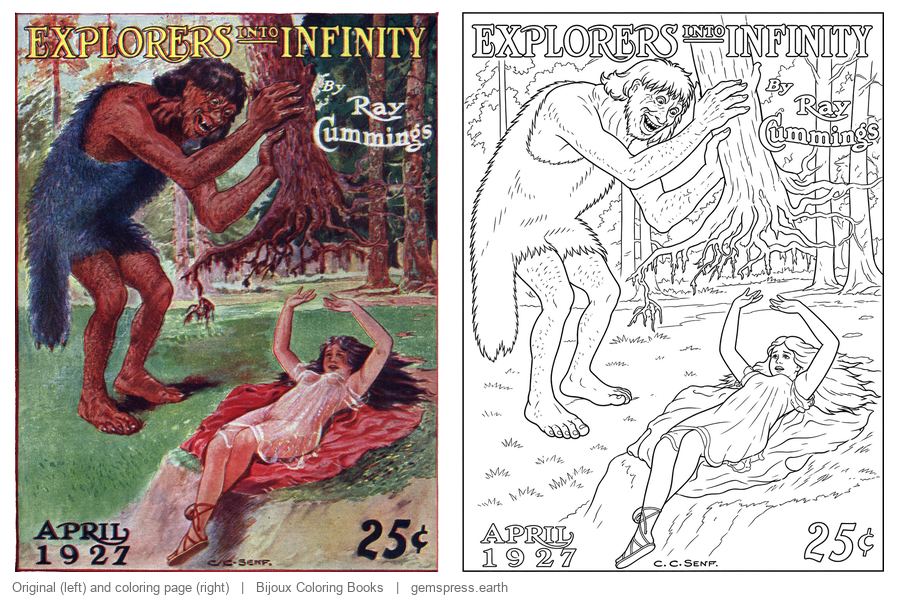
Weird Tales, April 1927. “Explorers into Infinity” by Ray Cummings, who worked as a personal assistant to Thomas Edison before turning to pulp fiction. The cover is by C. C. Senf.
Get this book: Weird Tales to Color Volume One →
“The Ghosts of Steamboat Coulee”
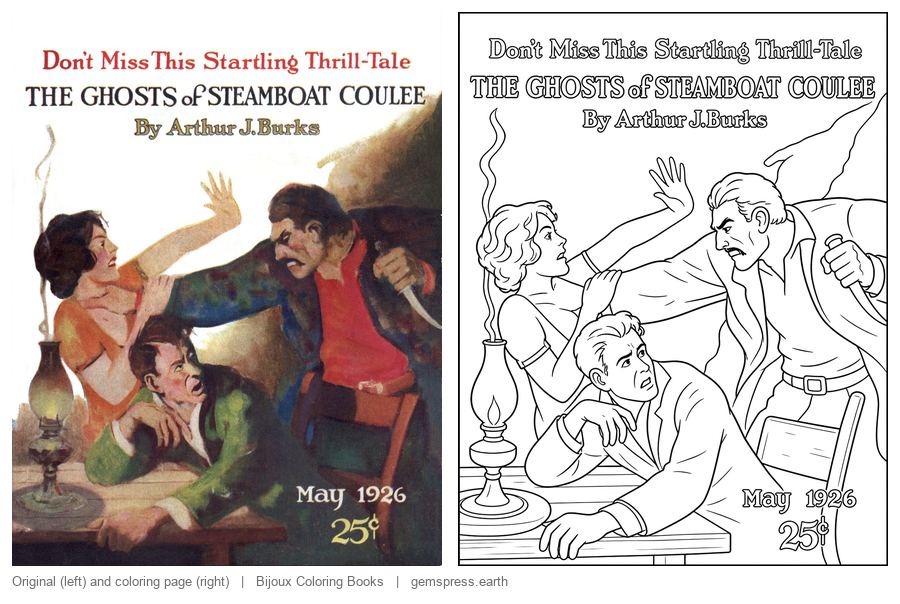
Weird Tales, May 1926. “Don’t Miss This Startling Thrill-Tale: The Ghosts of Steamboat Coulee” by Arthur J. Burks. A “coulee” is a steep-walled ravine, a word most associated with the Pacific Northwest. Weird Tales writers often set their horror in specific, real American landscapes. This cover’s artist credit hasn’t turned up, even in the most thorough sources.
Get this book: Weird Tales to Color Volume One →
“The Stolen Body”
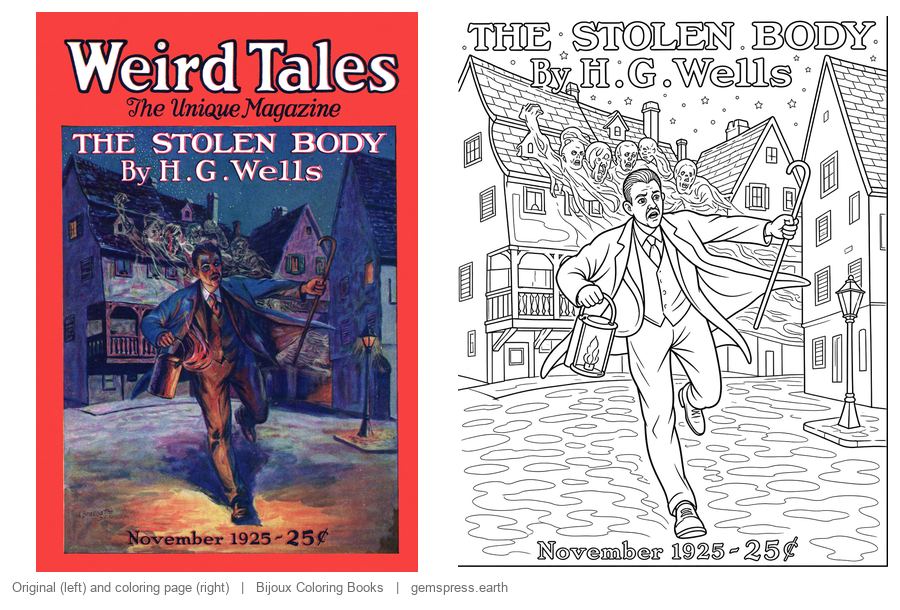
Weird Tales, November 1925. “The Stolen Body” by H. G. Wells. Wells was already world-famous by 1925, and reprinting him lent the young magazine credibility as much as entertainment. The cover is Andrew Brosnatch’s work.
Get this book: Weird Tales to Color Volume One →
“The Peacock’s Shadow”
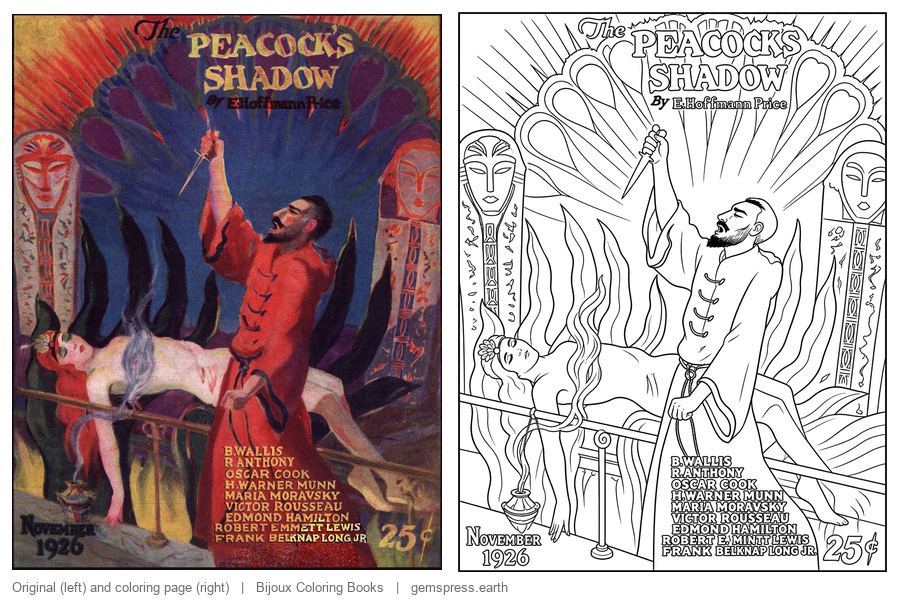
Weird Tales, November 1926. “The Peacock’s Shadow” by E. Hoffmann Price, who was fluent in several languages and had a genuine, lifelong interest in Islamic culture and history, which shows in his settings. This cover’s artist credit can’t be found.
Get this book: Weird Tales to Color Volume One →
“The Brain-Thief”
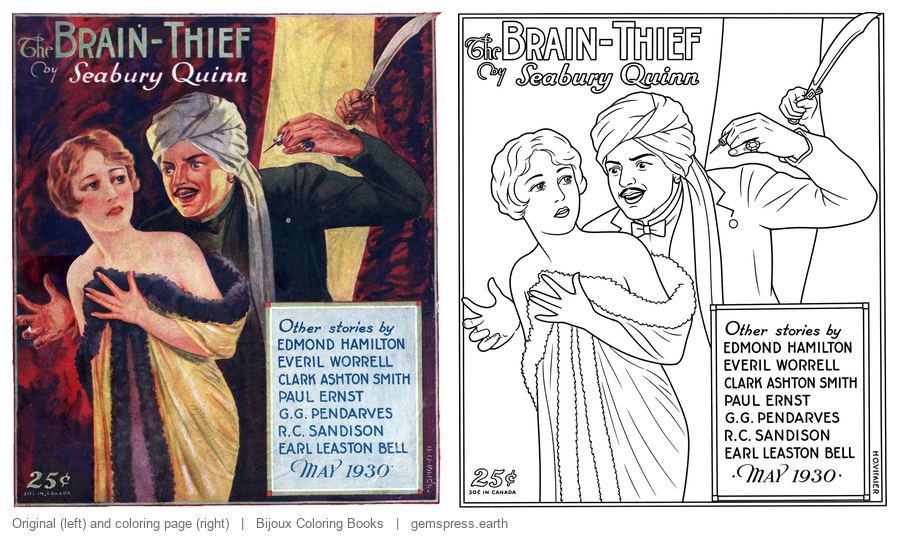
Weird Tales, May 1930. “The Brain-Thief” by Seabury Quinn. By reader popularity polls of the era, Quinn was the single most-read writer Weird Tales ever published, more popular in his day than Lovecraft. The cover is by C. C. Senf.
Get this book: Weird Tales to Color Volume One →
“The Bride of Dewer”
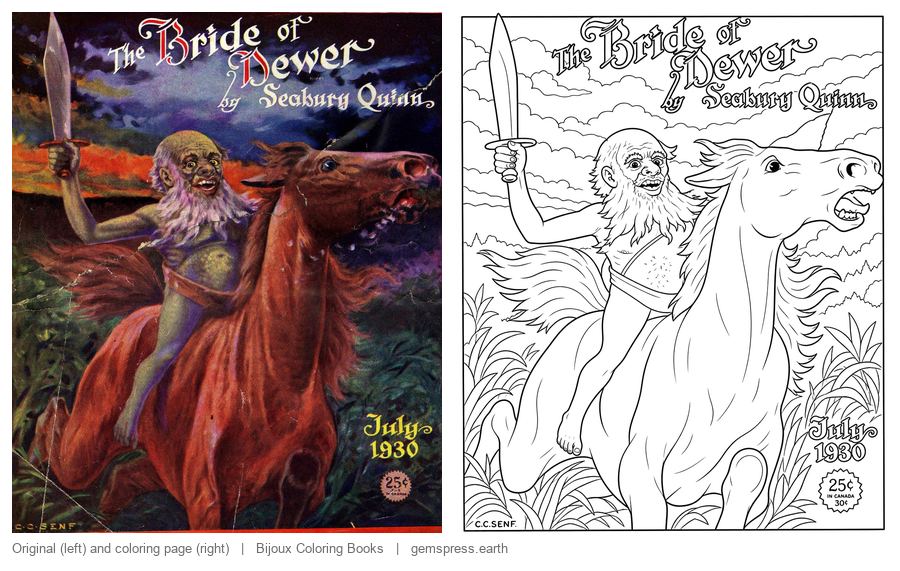
Weird Tales, July 1930. “The Bride of Dewer” by Seabury Quinn, who worked for years as a mortuary-industry trade journalist by day, writing horror fiction by night. The cover is by C. C. Senf.
Get this book: Weird Tales to Color Volume One →
“The Man Who Cast No Shadow”
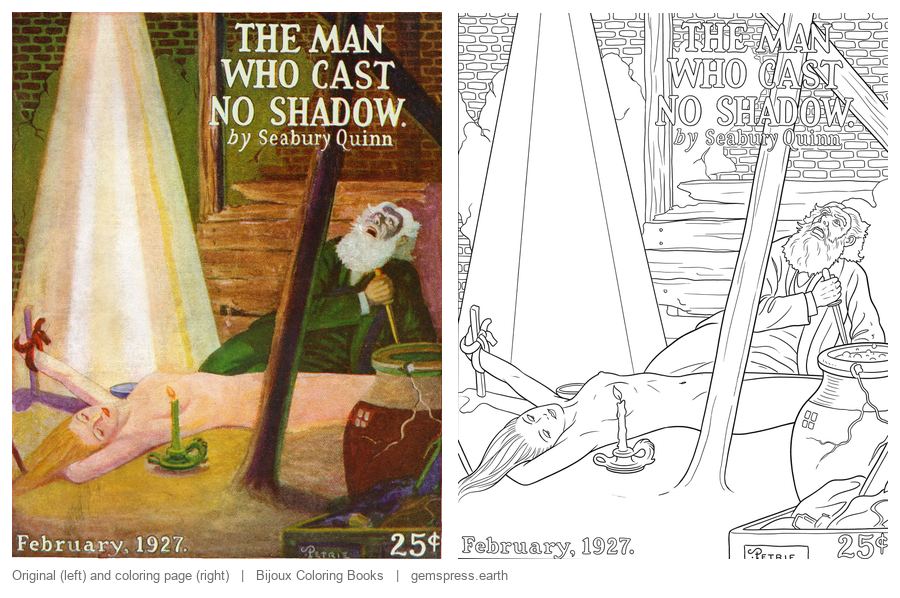
Weird Tales, February 1927. “The Man Who Cast No Shadow” by Seabury Quinn. This is a Jules de Grandin story. Quinn’s occult detective appeared in more than ninety Weird Tales stories. The cover is by C. Barker Petrie, Jr.
The author has indicated this post may contain content not suitable for all audiences.
Get this book: Weird Tales to Color Volume One →
“The Devil’s Rosary”
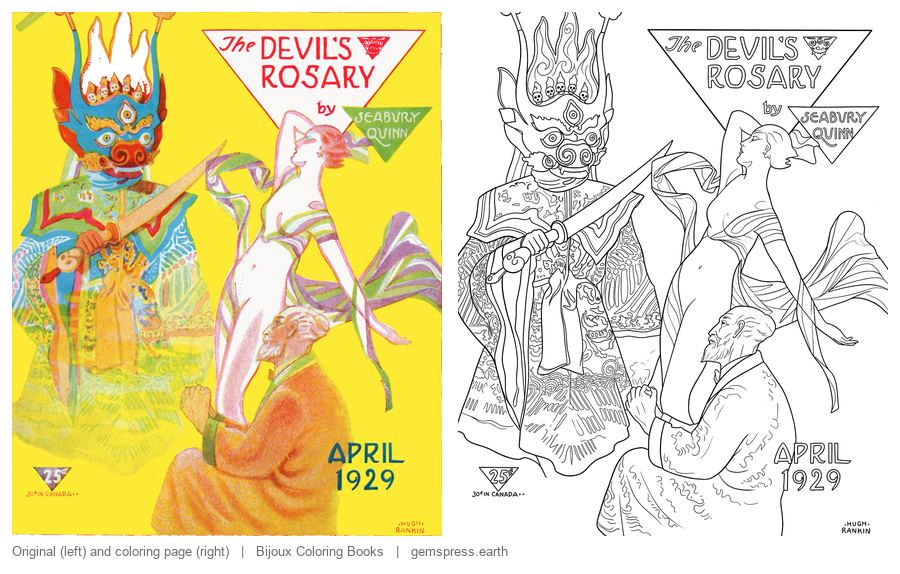
Weird Tales, April 1929. “The Devil’s Rosary” by Seabury Quinn, who was bankable enough that Weird Tales sometimes printed his name larger than the magazine’s own logo. The cover is by Hugh Rankin.
The author has indicated this post may contain content not suitable for all audiences.
Get this book: Weird Tales to Color Volume One →
Want to try before you buy? Print free sample pages at gemspress.earth/free-coloring-pages.