Every page in Chromatic Wood Type Specimens to Color Volume Two began as a real piece of historical art. Here are 26 of them: the original on the left, our coloring page on the right, and the story behind each one.
Get the book: Chromatic Wood Type Specimens to Color Volume Two
“Mixed Bold Hue”
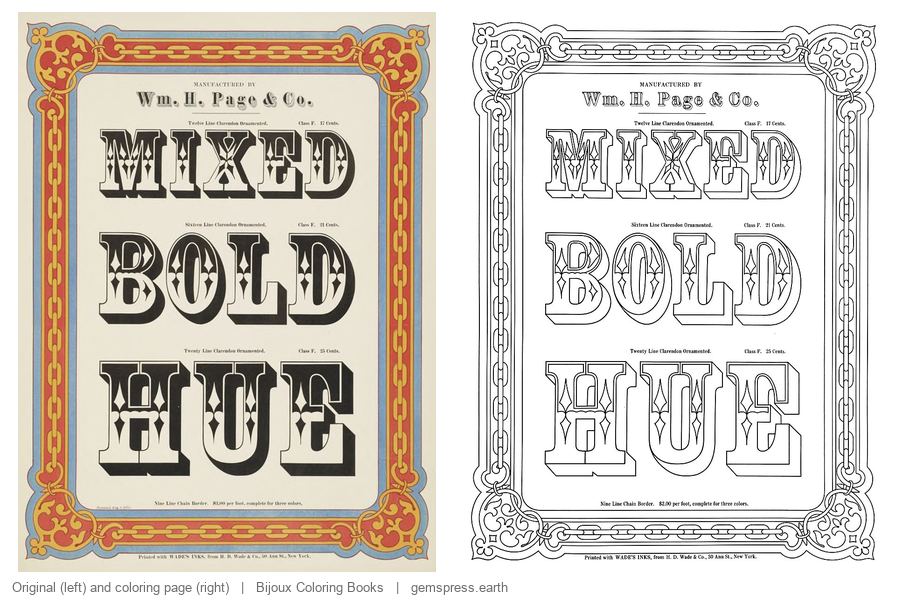
From the 1874 sales catalog of William H. Page & Co., wood type manufacturers. This book was never sold to the public. It was a traveling salesman’s sample catalog, shown to print-shop owners who ordered type by mail using the names and prices printed right on each design. (Twelve Line Clarendon Ornamented, Class F, 17 cents. Nine Line Chain Border, $2.00 per foot.)
Chromatic type like this was built from several wood blocks, each inked a different hue and printed in a separate pass. Which makes it perfect for coloring.
Free to print: this page is in our free Sampler Pack. Get the free pages.
Get this book: Chromatic Wood Type Specimens to Color Volume Two →
“Demoralized Organization”
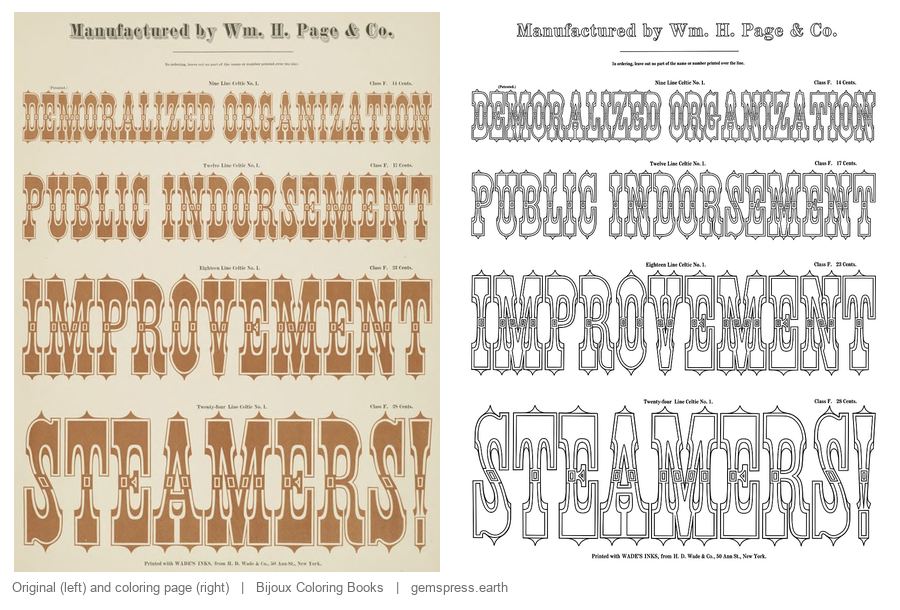
From the 1874 sales catalog of William H. Page & Co., wood type manufacturers. The sample words were picked to show off the letterforms.
Get this book: Chromatic Wood Type Specimens to Color Volume Two →
“Detriment Prison Untie”
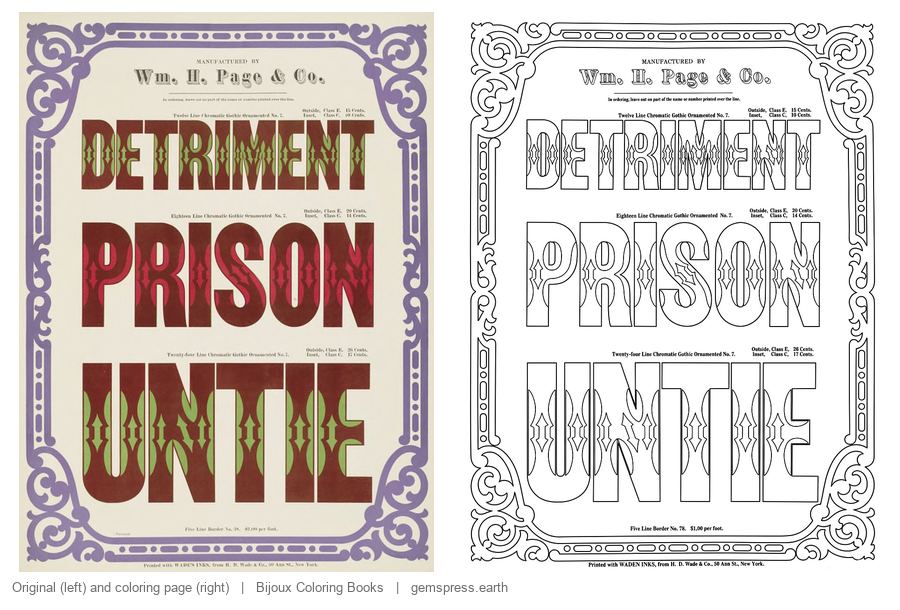
From the 1874 sales catalog of William H. Page & Co., wood type manufacturers. Page’s staff picked these three words to show off different letterforms.
Get this book: Chromatic Wood Type Specimens to Color Volume Two →
The Giant M
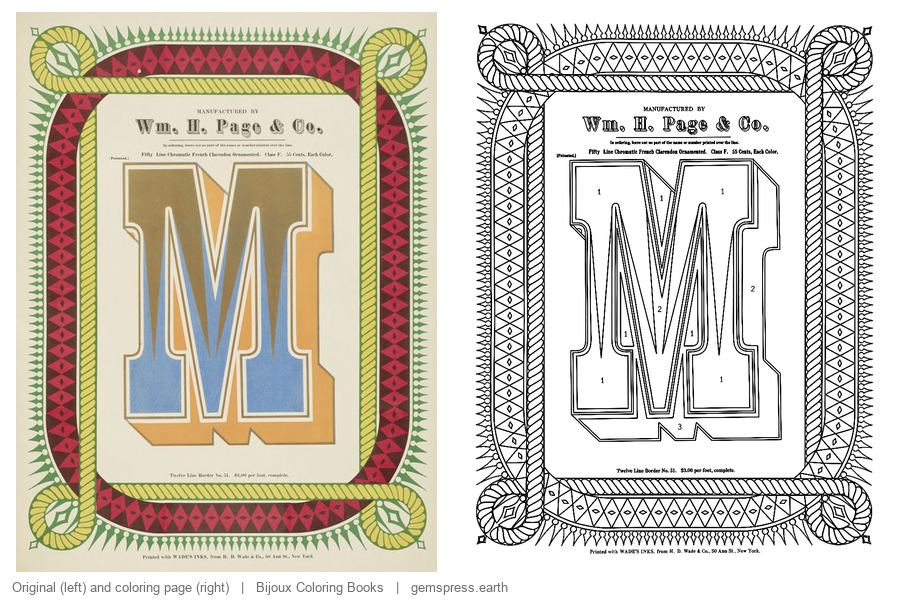
From the 1874 sales catalog of William H. Page & Co., wood type manufacturers: one enormous letter M, in Fifty Line Chromatic French Clarendon Ornamented.
This plate is the clearest demonstration in the whole book of how chromatic type was printed. The giant M is marked with small printed numbers (1, 1, 1, 2, 2, 3) showing the printer exactly which sections of the letter belonged to which color pass. It’s essentially a paint-by-numbers key for three-color printing.
Which means that 152 years later, it’s still telling you how to color it. (You’re allowed to ignore it.)
Get this book: Chromatic Wood Type Specimens to Color Volume Two →
“Prowling Tigers Bush”
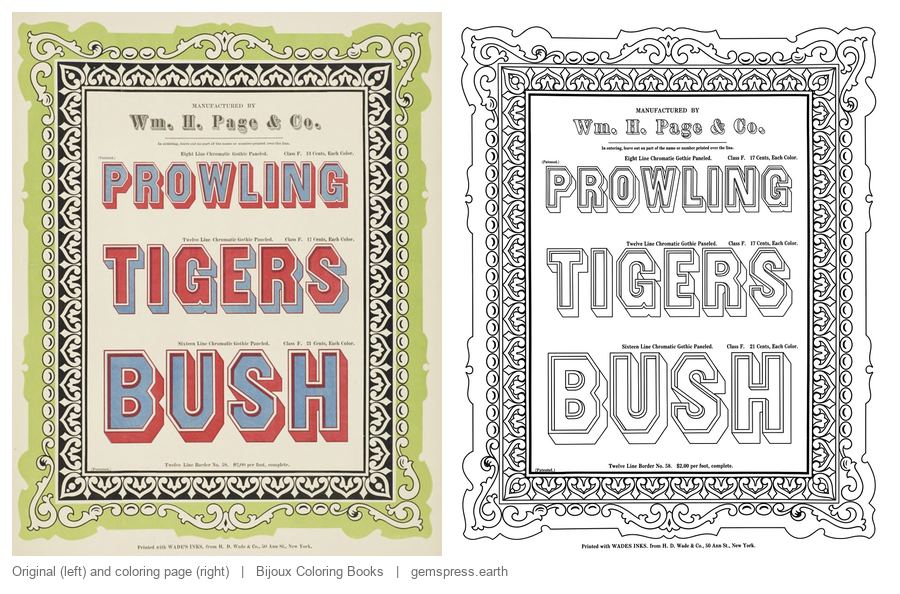
From the 1874 sales catalog of William H. Page & Co., wood type manufacturers. “Gothic,” confusingly to modern ears, was standard 19th-century American printers’ terminology for what we’d now call sans-serif. The usage lasted in the printing trade well into the 20th century.
Get this book: Chromatic Wood Type Specimens to Color Volume Two →
“Sour Drink Boarding Belgian”
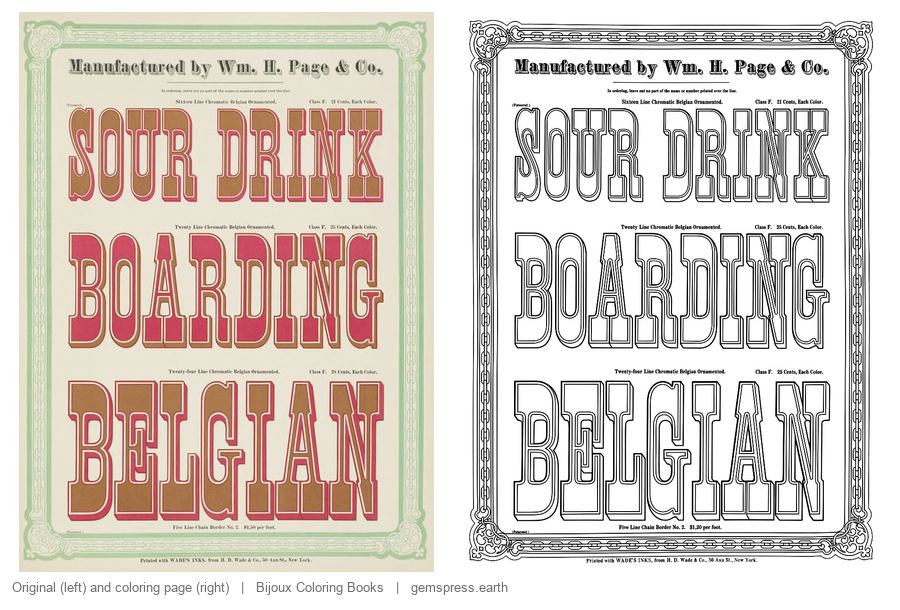
From the 1874 sales catalog of William H. Page & Co., wood type manufacturers. The typeface is Chromatic Belgian Ornamented, and the sample words actually spell out “Belgian” itself on the third line. It’s one of the few plates in the whole book where the demonstration text names the typeface it’s showing off.
Get this book: Chromatic Wood Type Specimens to Color Volume Two →
“Impeached Ground Birch”
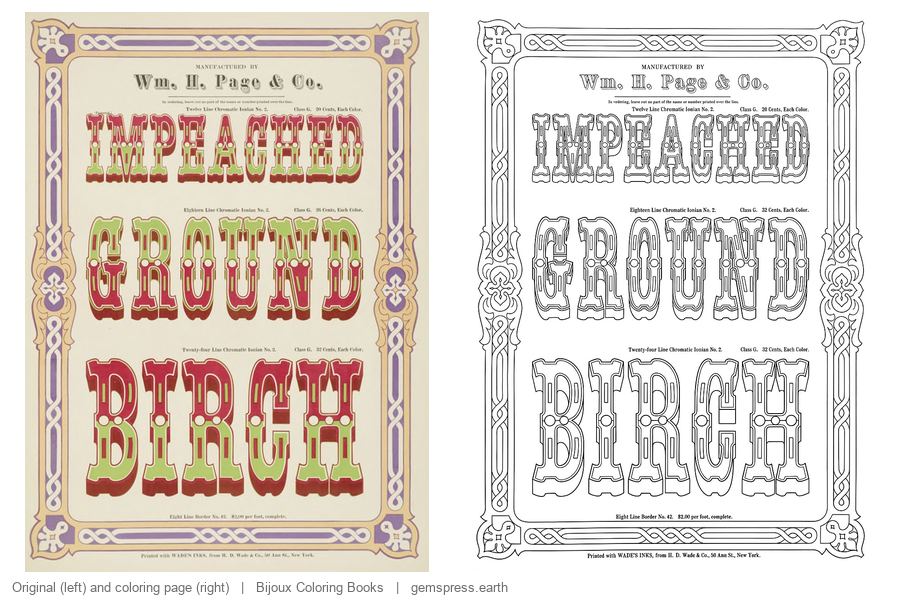
From the 1874 sales catalog of William H. Page & Co., wood type manufacturers. “Impeached” was a loaded word choice for 1874. Andrew Johnson’s impeachment trial, the first ever for a sitting American president, had taken place just six years earlier.
Get this book: Chromatic Wood Type Specimens to Color Volume Two →
“Tea Merchant Pine Island Journals Chide”
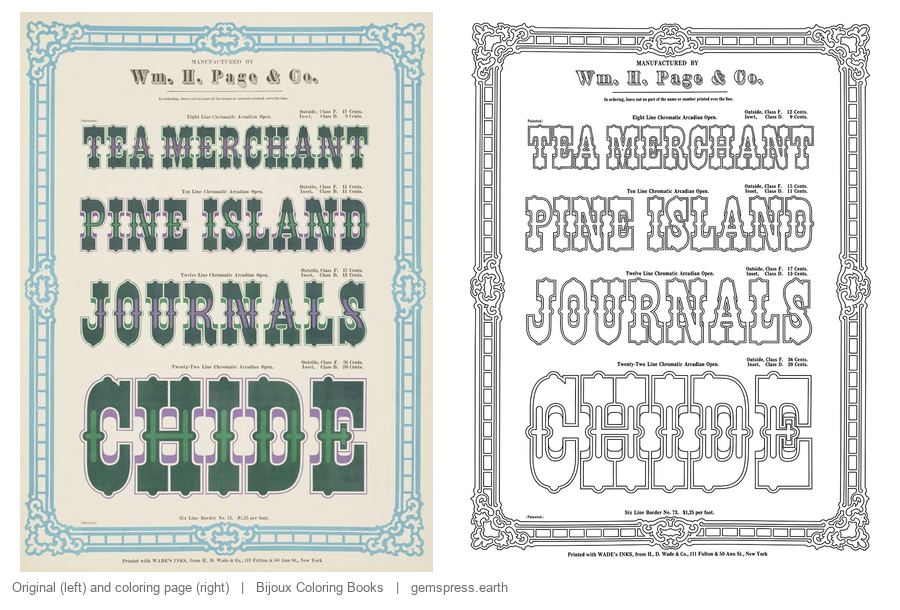
From the 1874 sales catalog of William H. Page & Co., wood type manufacturers. “Tea Merchant” reflects a very common customer for big display type. Advertising for shops, warehouses and trade signs was one of wood type’s biggest markets, long before wood type became associated, as it often is today, with circus posters and playbills.
Get this book: Chromatic Wood Type Specimens to Color Volume Two →
“Boston Sketch Introduce Housed Since”
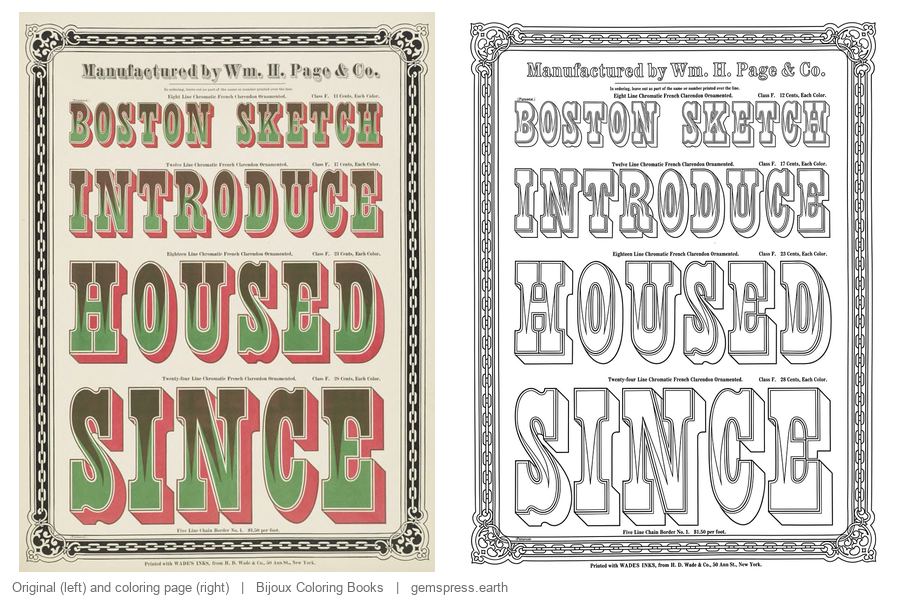
From the 1874 sales catalog of William H. Page & Co., wood type manufacturers. Five unrelated words stacked on one plate is typical of how these specimen books were built.
Get this book: Chromatic Wood Type Specimens to Color Volume Two →
“Brushed Design House”
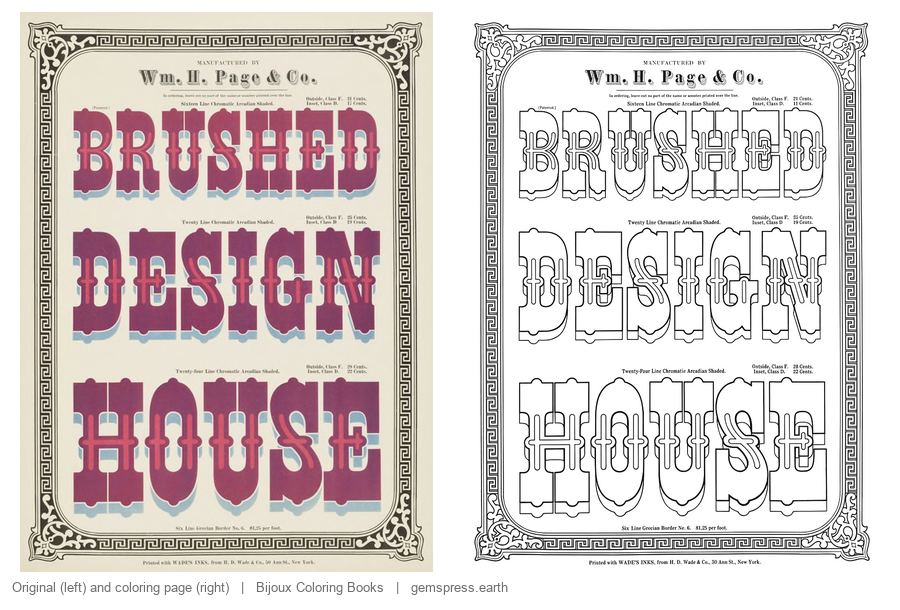
From the 1874 sales catalog of William H. Page & Co., wood type manufacturers. The decorative border here is a Grecian border, one of many border names in Page’s catalog borrowed from classical architecture.
Get this book: Chromatic Wood Type Specimens to Color Volume Two →
“Champion Bronzes Tinder Unite Hem”
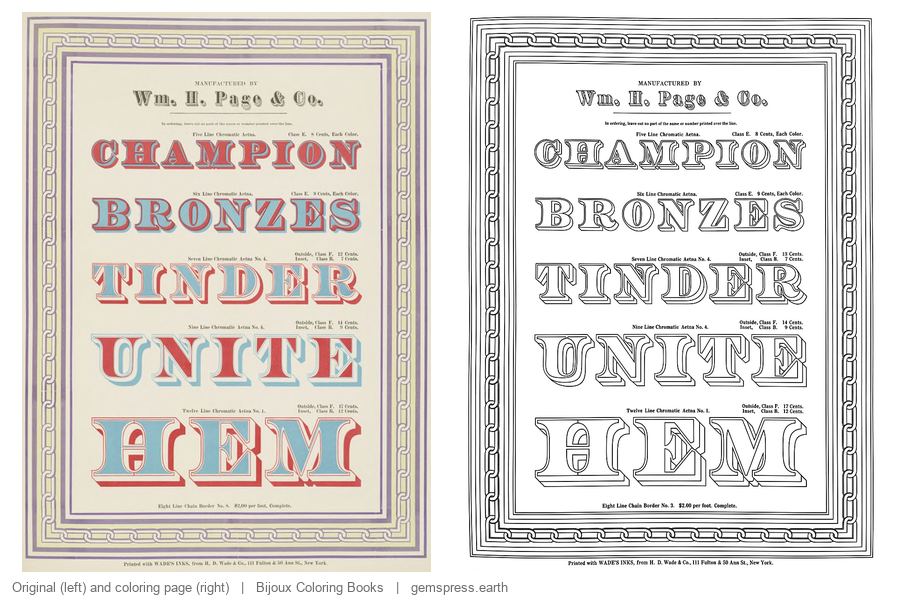
From the 1874 sales catalog of William H. Page & Co., wood type manufacturers. Page’s staff needed short words with a good spread of different letters.
Get this book: Chromatic Wood Type Specimens to Color Volume Two →
“Durable Designs! Worshipers Celebration”
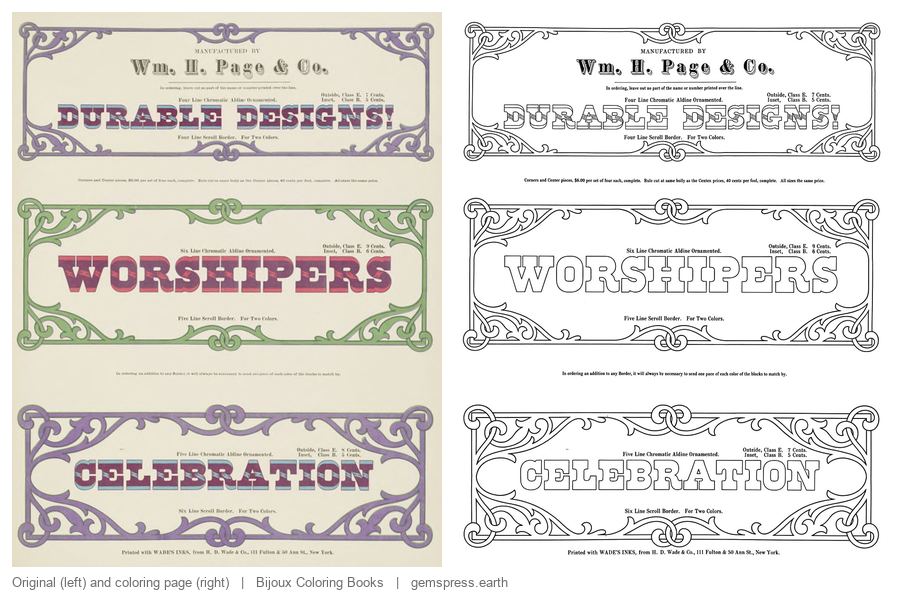
From the 1874 sales catalog of William H. Page & Co., wood type manufacturers.
Get this book: Chromatic Wood Type Specimens to Color Volume Two →
“Erudition Bluster Pines”
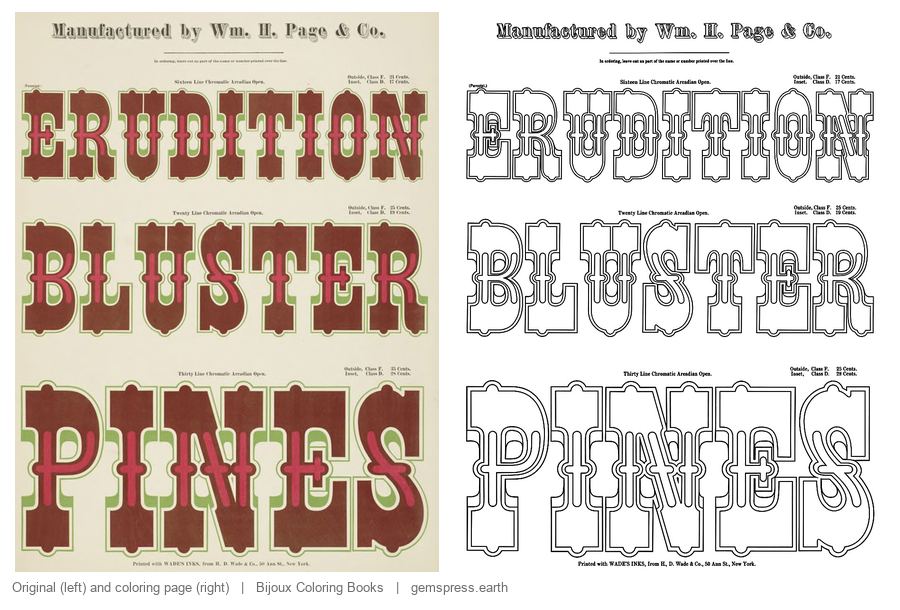
From the 1874 sales catalog of William H. Page & Co., wood type manufacturers. “Erudition” was a good word for a type specimen book: educational institutions and lecture halls were among the customers for big display type like this.
Get this book: Chromatic Wood Type Specimens to Color Volume Two →
“Fine Ornaments Reading Hues”
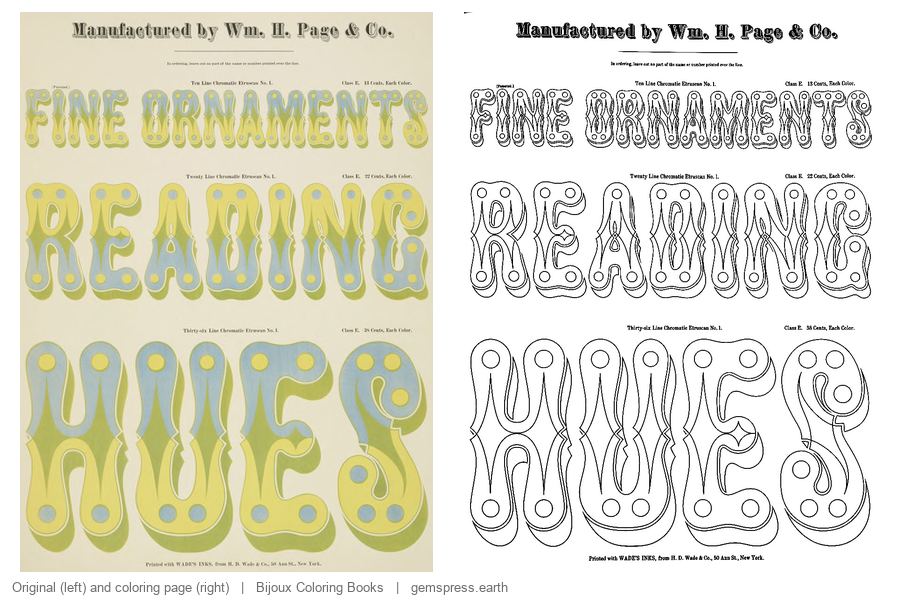
From the 1874 sales catalog of William H. Page & Co., wood type manufacturers.
Get this book: Chromatic Wood Type Specimens to Color Volume Two →
“Grand March! Distinguish Routine Proud”
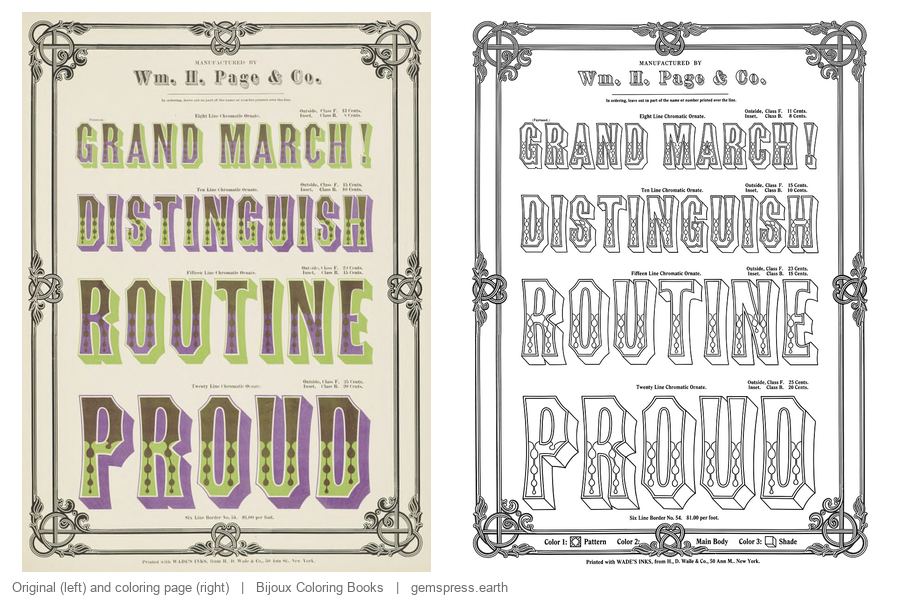
From the 1874 sales catalog of William H. Page & Co., wood type manufacturers.
This plate includes a printed color key at the bottom, identifying exactly which part of each letter is “Color 1: Pattern,” “Color 2: Main Body” and “Color 3: Shade.” It’s a practical guide for a printer trying to reproduce the same three-color effect.
Get this book: Chromatic Wood Type Specimens to Color Volume Two →
“Marines Normandy Merchant Thrones Providence”
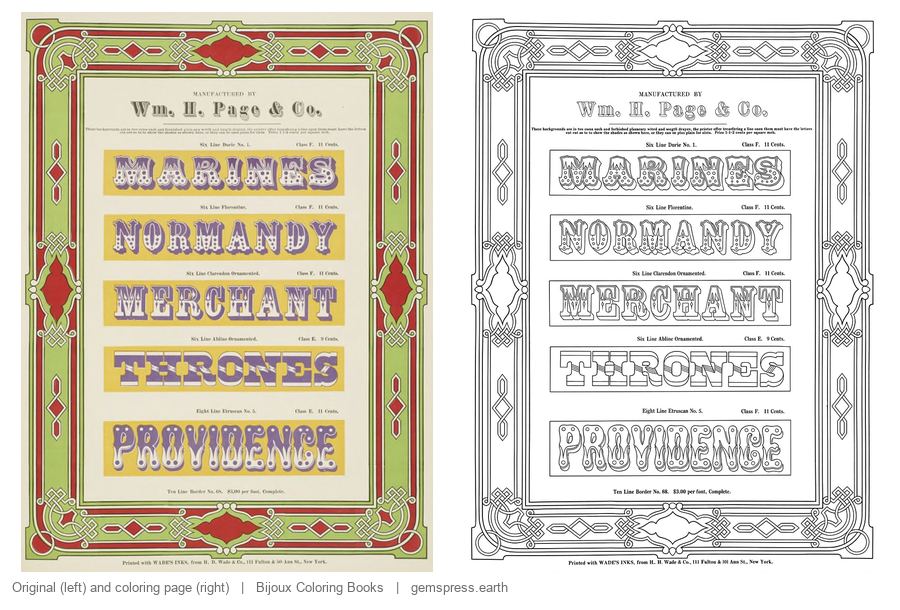
From the 1874 sales catalog of William H. Page & Co., wood type manufacturers. The fine print explains that the diamond-patterned backgrounds behind these words were sold separately from the letters, priced by the square inch. A printer could order plain type, textured type, or anything in between, each at a different cost.
Get this book: Chromatic Wood Type Specimens to Color Volume Two →
“Mingle Kind Bound Gem”
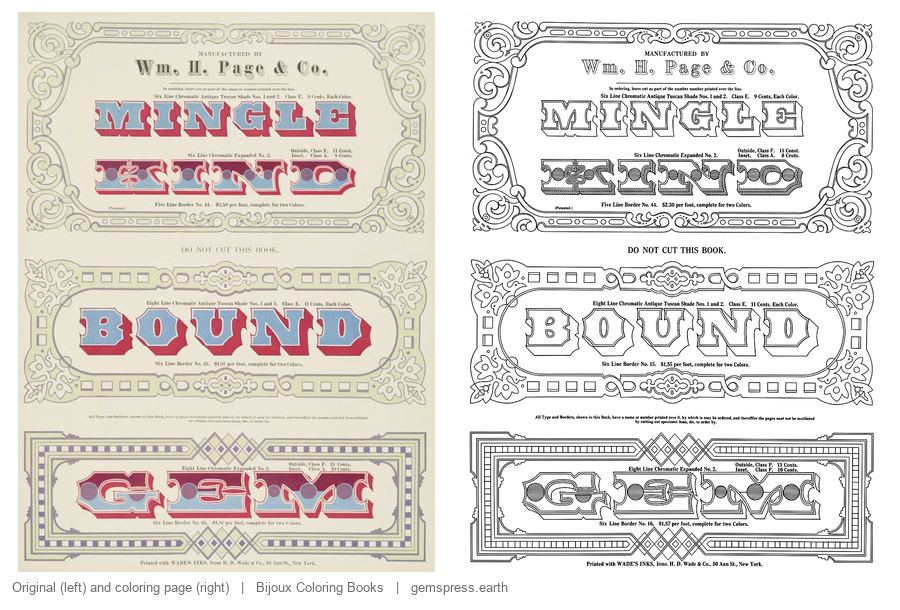
From the 1874 sales catalog of William H. Page & Co., wood type manufacturers.
This plate repeats the printed warning “DO NOT CUT THIS BOOK.” The catalog was a working sales tool that traveling agents carried from print shop to print shop.
Get this book: Chromatic Wood Type Specimens to Color Volume Two →
“Mounds Hue”
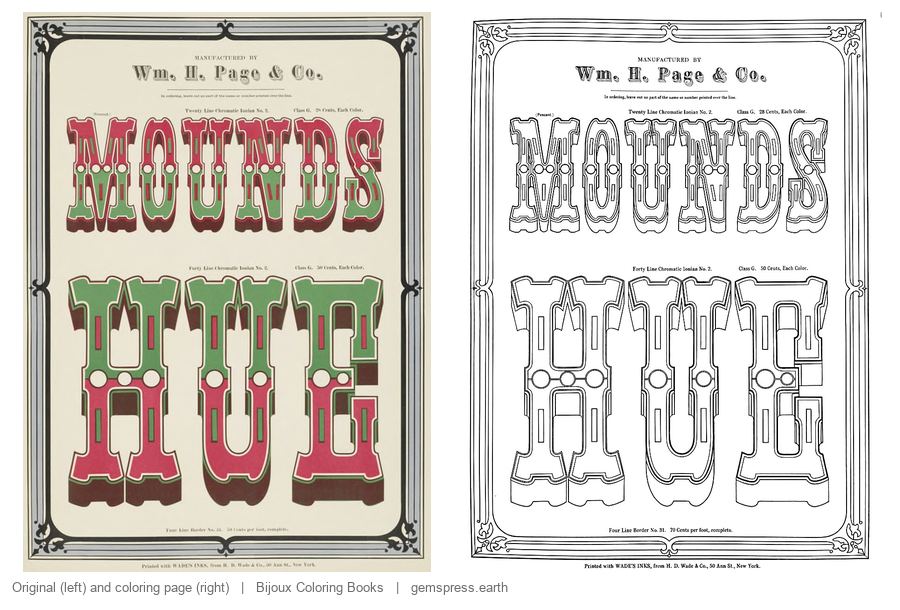
From the 1874 sales catalog of William H. Page & Co., wood type manufacturers, in Chromatic Ionian No. 2. At forty lines tall, the largest size shown here, a single carved wood letter would stand roughly five and a half inches, priced at 50 cents per letter, per color.
Get this book: Chromatic Wood Type Specimens to Color Volume Two →
“Norwich Mile Sit”
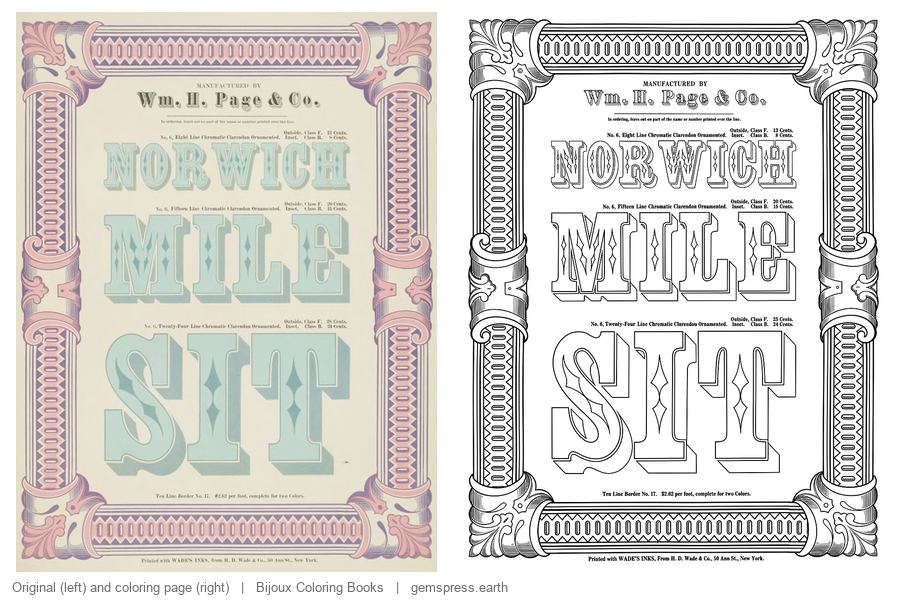
From the 1874 sales catalog of William H. Page & Co., wood type manufacturers, in Chromatic Clarendon Ornamented No. 6. Norwich” is the Connecticut town where William H. Page’s company was headquartered by the time this book was printed.
Get this book: Chromatic Wood Type Specimens to Color Volume Two →
“Prints Hose”
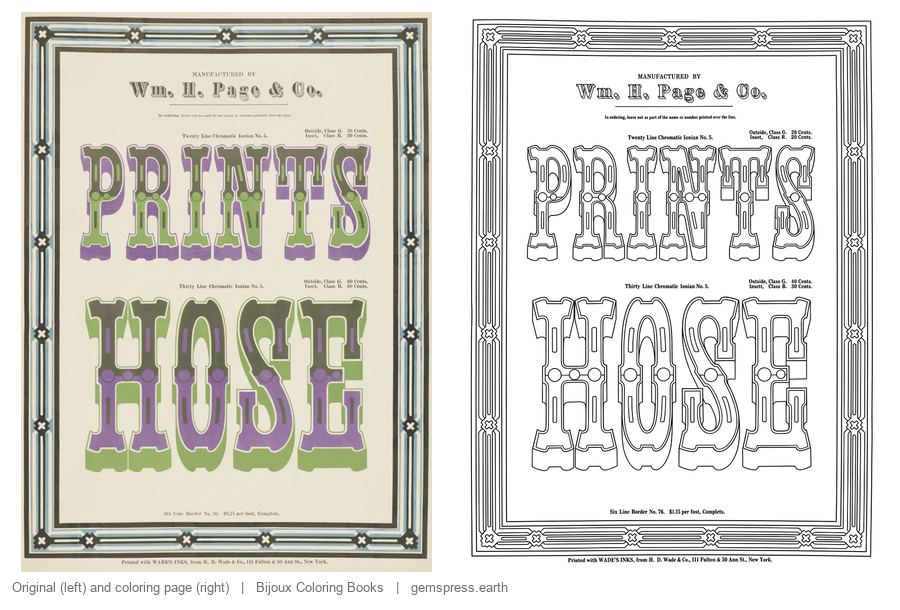
From the 1874 sales catalog of William H. Page & Co., wood type manufacturers, in Chromatic Ionian No. 5.
Get this book: Chromatic Wood Type Specimens to Color Volume Two →
“Ranche Mown Hire Dun”
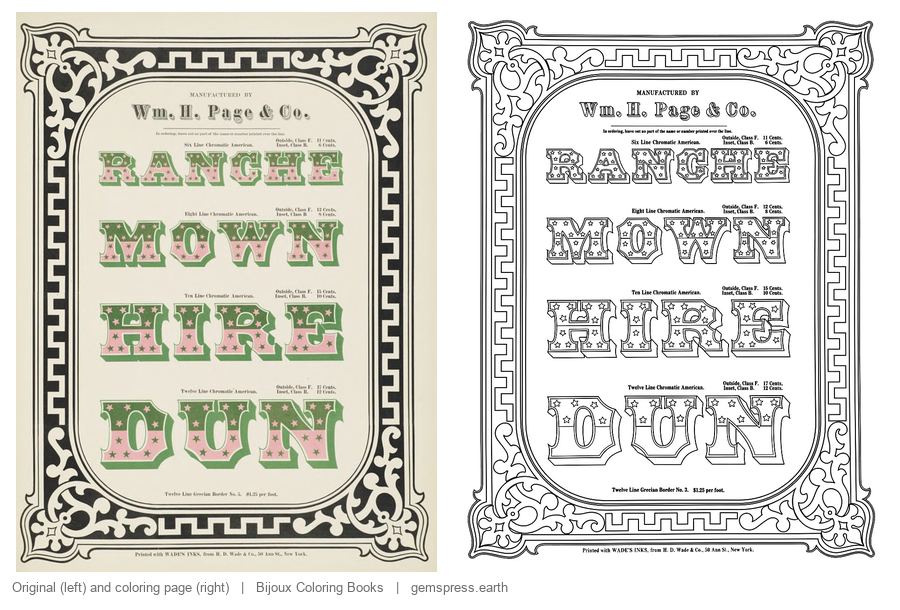
From the 1874 sales catalog of William H. Page & Co., wood type manufacturers, in Chromatic American. Every letter of this typeface is decorated with a small five-pointed star. It’s an openly patriotic design, published just two years before the United States’ 1876 Centennial celebrations, when patriotic ornament of this kind was in especially high demand.
Get this book: Chromatic Wood Type Specimens to Color Volume Two →
“Recount Humor Rude”
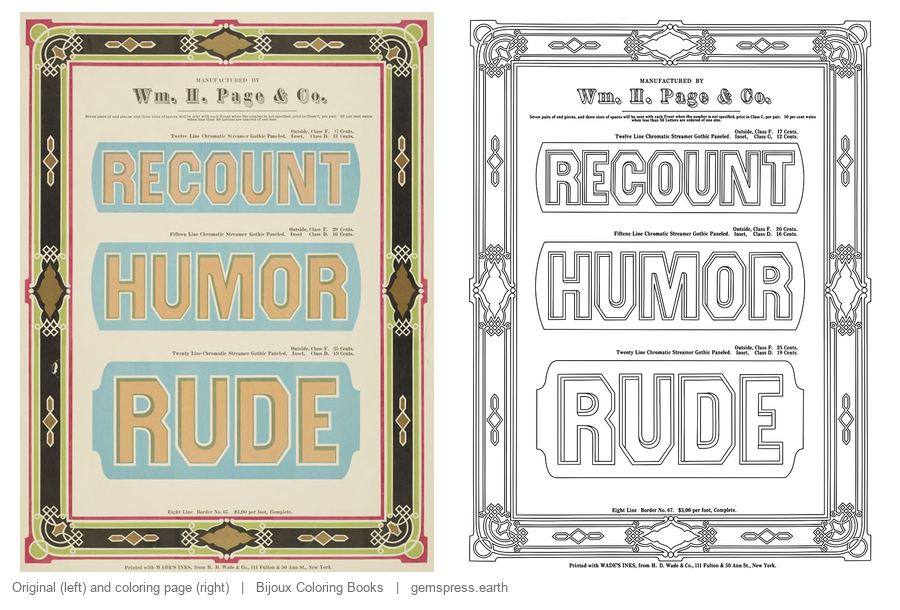
From the 1874 sales catalog of William H. Page & Co., wood type manufacturers, in Chromatic Streamer Gothic Paneled. Streamer faces like this one, set inside a ribbon-shaped banner, were designed for a single line of bold text: the 19th-century version of a banner headline, built to be read at a glance.
Get this book: Chromatic Wood Type Specimens to Color Volume Two →
“Rowing Public Make”
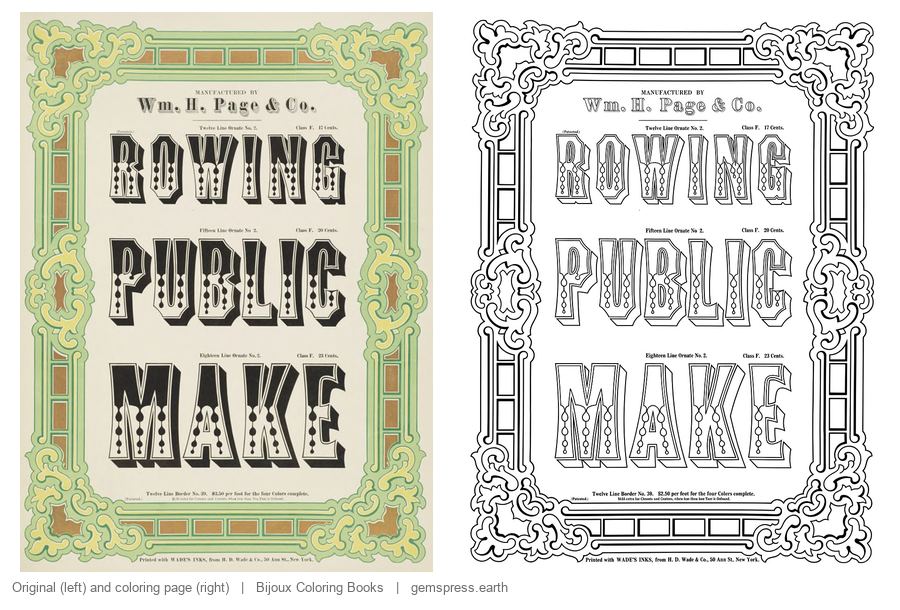
From the 1874 sales catalog of William H. Page & Co., wood type manufacturers, in Ornate No. 2. The border alone is priced “for the four Colors complete,” which means this design ran through the press four separate times, one per color. That’s more elaborate than most plates in the collection, which usually show two or three.
Get this book: Chromatic Wood Type Specimens to Color Volume Two →
“Rugs Hoi”
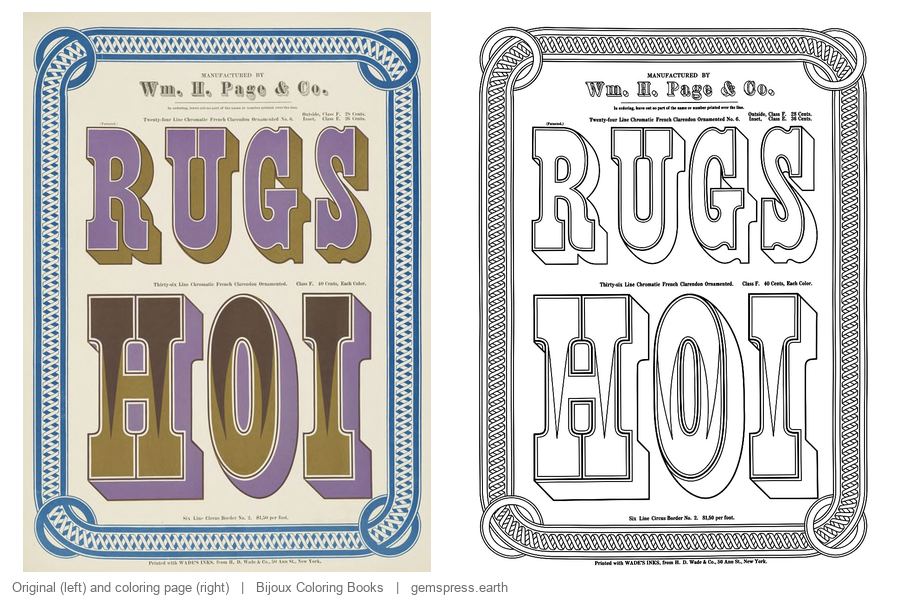
From the 1874 sales catalog of William H. Page & Co., wood type manufacturers, in Chromatic French Clarendon Ornamented No. 6. This plate shows the same typeface at two different sizes: “Rugs” at twenty-four lines tall (about three and a half inches per letter), and “Hoi” at a full thirty-six lines, around five inches per letter, among the largest sizes shown anywhere in the book.
Get this book: Chromatic Wood Type Specimens to Color Volume Two →
“Storm Shun Bug”
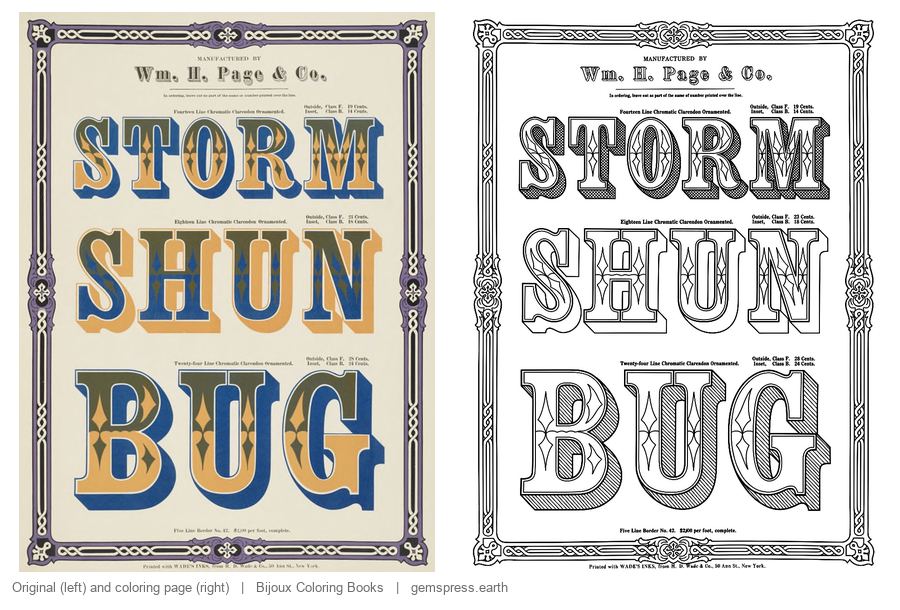
From the 1874 sales catalog of William H. Page & Co., wood type manufacturers, in Chromatic Clarendon Ornamented. Wood wasn’t a printer’s only option in 1874. Metal type was still standard for body text and smaller sizes, but wood stayed dominant for big display faces like these, because carving wood was far cheaper than casting oversized metal type.
Get this book: Chromatic Wood Type Specimens to Color Volume Two →
“Throwing Models Bird”
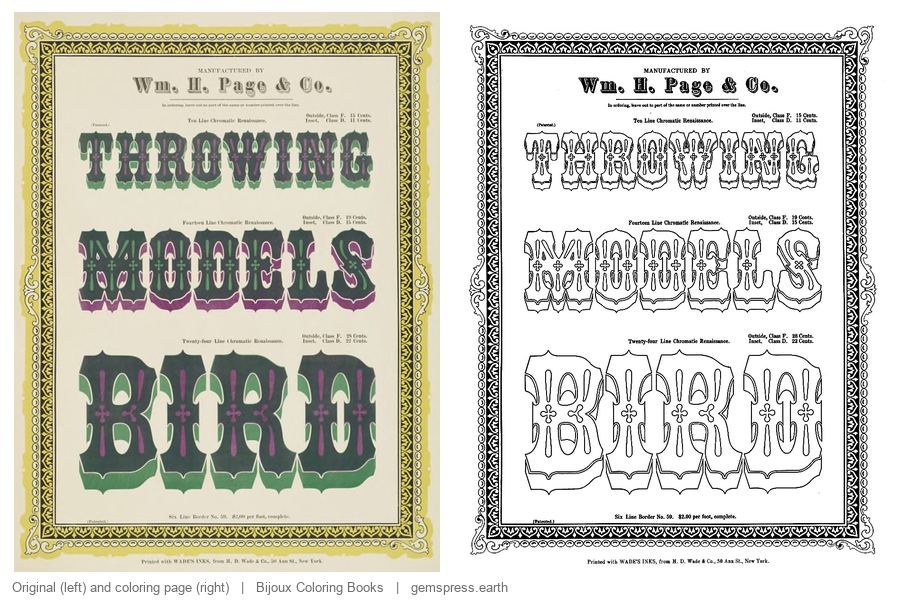
From the 1874 sales catalog of William H. Page & Co., wood type manufacturers, in Chromatic Renaissance.
Get this book: Chromatic Wood Type Specimens to Color Volume Two →
Want to try before you buy? Print free sample pages at gemspress.earth/free-coloring-pages.
Get the book: Chromatic Wood Type Specimens to Color Volume Two