Every page in Dante's Divine Comedy to Color began as a real piece of historical art. Here are 26 of them: the original on the left, our coloring page on the right, and the story behind each one.
Get the book: Dante's Divine Comedy to Color
The Terrace of the Greedy
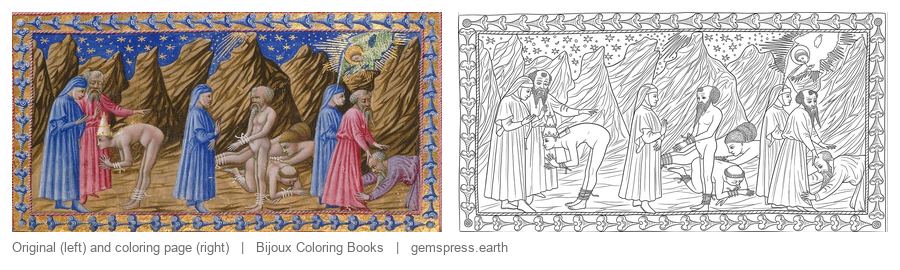
Dante’s Purgatorio, cantos 19–21: the terrace of the greedy, where souls lie face-down, bound hand and foot, weeping into the dust. Among them is a pope, Adrian V. Also here is Statius, a real Roman poet whom Dante reinvents as a secret Christian convert.
Painted by Priamo della Quercia in Yates Thompson MS 36, a Sienese manuscript made around 1444–1450, now in the British Library.
The author has indicated this post may contain content not suitable for all audiences.
Get this book: Dante's Divine Comedy to Color →
Dante and Charon
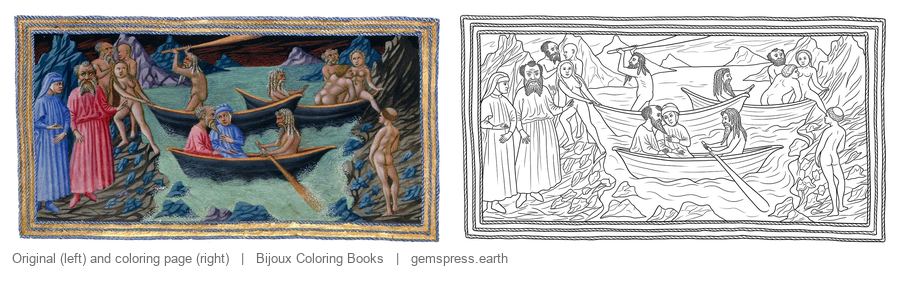
Dante’s Inferno: Dante being rowed by Charon across the River Acheron, while the souls of the dead crowd the shore and fill the other boats. Charon is from Virgil’s Aeneid, where he rows the dead across the underworld’s rivers. It’s a fitting borrow, since Virgil is the character guiding Dante through the poem.
Painted by Priamo della Quercia in Yates Thompson MS 36, a Sienese manuscript made around 1444–1450, now in the British Library.
The author has indicated this post may contain content not suitable for all audiences.
Get this book: Dante's Divine Comedy to Color →
Dante in the Wood of the Suicides
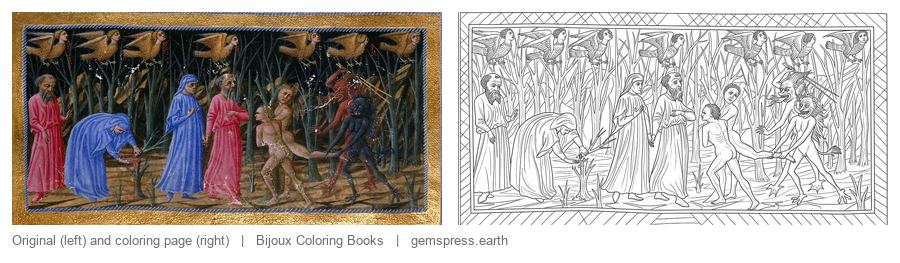
Dante’s Inferno: Dante breaking a branch in the wood of the suicides.
In Dante’s Hell, suicides are transformed into gnarled, thorny trees, and they can only speak by having part of themselves torn off. That’s what happens when Dante snaps a twig from the tree that was once Piero delle Vigne.
Painted by Priamo della Quercia in Yates Thompson MS 36, a Sienese manuscript made around 1444-1450, now in the British Library.
The author has indicated this post may contain content not suitable for all audiences.
Get this book: Dante's Divine Comedy to Color →
Theseus and Ariadne
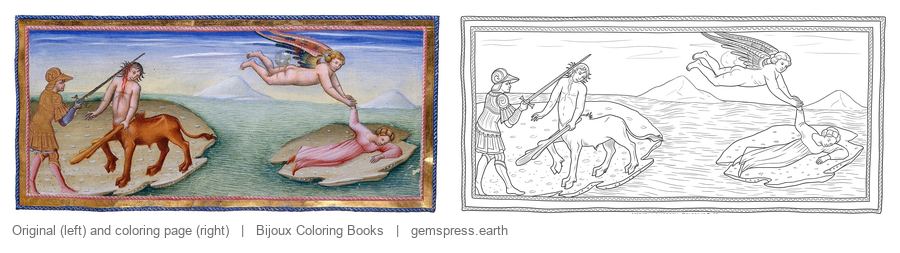
Dante’s Paradiso: the legends of Theseus and Ariadne.
Dante compares two circling rings of dancing, singing souls to the constellation Corona Borealis. Classical myth held that the constellation was Ariadne’s crown, flung into the sky after her story ends. So the artist painted her story: a hero with a club, a creature that’s half man and half bull, and a winged figure lifting Ariadne from the shore.
Painted by Giovanni di Paolo in Yates Thompson MS 36, a Sienese manuscript made around 1444-1450, now in the British Library.
The author has indicated this post may contain content not suitable for all audiences.
Free to print: this page is in our free Sampler Pack. Get the free pages.
Get this book: Dante's Divine Comedy to Color →
Dante Among the Simoniacs
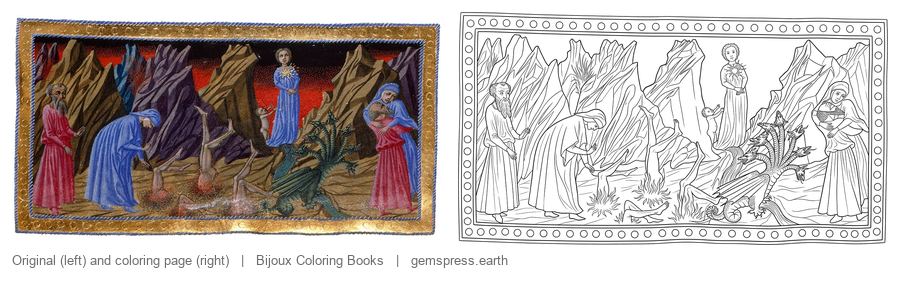
Dante’s Inferno: Dante and Virgil among the simoniacs, with Pope Nicholas III. Simony was the buying or selling of church office. Its punishment: guilty popes are jammed head-first into holes in the rock, with only their burning feet sticking out. It’s a literal image of the poet’s accusation that the church had turned its own values upside down.
Painted by Priamo della Quercia in Yates Thompson MS 36, a Sienese manuscript made around 1444-1450, now in the British Library.
The author has indicated this post may contain content not suitable for all audiences.
Get this book: Dante's Divine Comedy to Color →
The Heaven of Jupiter
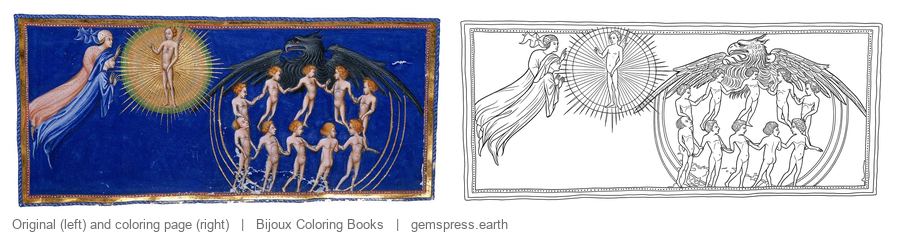
Dante’s Paradiso: Dante and Beatrice ascending to the Heaven of Jupiter.
Painted by Giovanni di Paolo in Yates Thompson MS 36, a Sienese manuscript made around 1444-1450, now in the British Library.
The author has indicated this post may contain content not suitable for all audiences.
Get this book: Dante's Divine Comedy to Color →
Vanni Fucci and Cacus
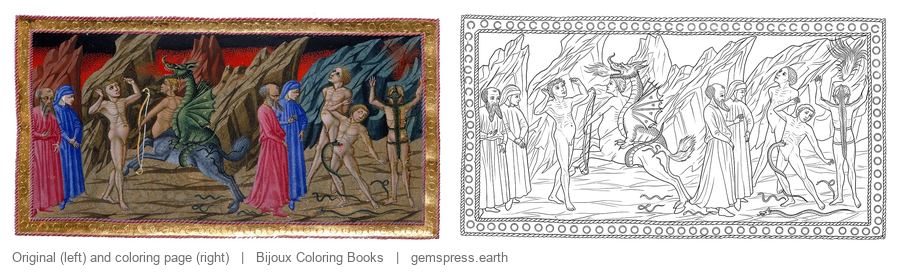
Dante’s Inferno: Vanni Fucci attacked by Cacus, among the thieves.
Fucci’s punishment includes bursting into flames, crumbling to ash and reassembling himself, phoenix-style, over and over. Dante makes the comparison explicit. Then he has Fucci make an obscene gesture at God, which the poet calls the vilest act he witnesses anywhere in Hell.
Painted by Priamo della Quercia in Yates Thompson MS 36, a Sienese manuscript made around 1444-1450, now in the British Library.
The author has indicated this post may contain content not suitable for all audiences.
Get this book: Dante's Divine Comedy to Color →
Dante Meets Adam
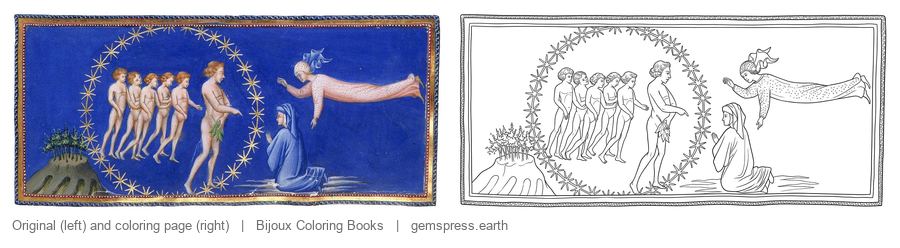
Dante’s Paradiso: Beatrice watching as Dante kneels before Adam.
Dante gets to interview the first man, and he asks practical questions: how long Adam lived in Eden before the Fall (a matter of hours, it turns out), and what language he originally spoke.
Painted by Giovanni di Paolo in Yates Thompson MS 36, a Sienese manuscript made around 1444-1450, now in the British Library.
The author has indicated this post may contain content not suitable for all audiences.
Get this book: Dante's Divine Comedy to Color →
Dante at the Bottom of Hell
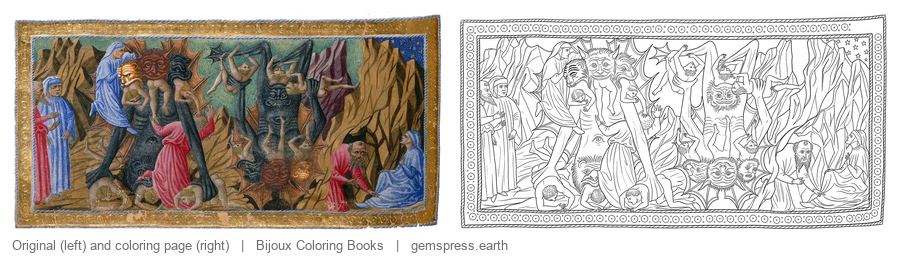
Dante’s Inferno: Dis, biting Cassius, Judas and Brutus.
At the very bottom of Hell, the three-faced Dis (Lucifer) chews on history’s three worst traitors, one in each mouth. Brutus and Cassius are there alongside Judas Iscariot because, to Dante, betraying Julius Caesar was a betrayal of civil order on a par with betraying Christ.
Painted by Priamo della Quercia in Yates Thompson MS 36, a Sienese manuscript made around 1444-1450, now in the British Library.
The author has indicated this post may contain content not suitable for all audiences.
Get this book: Dante's Divine Comedy to Color →
How Hell Is Sorted
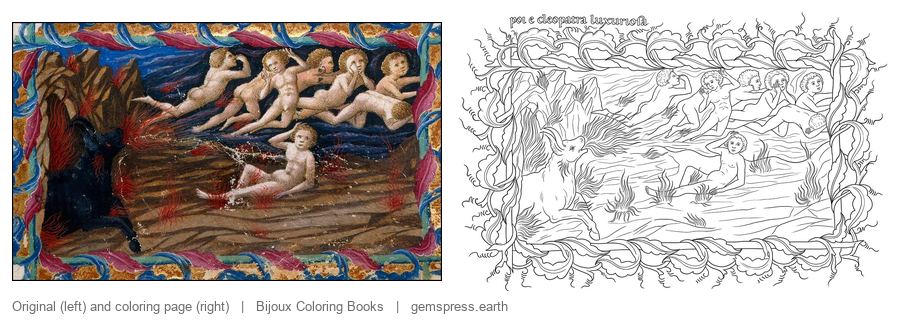
Dante’s Inferno: the cardinal sinners being punished in Hell.
Dante’s Inferno doesn’t sort sinners by the seven deadly sins. It sorts them by which kind of love they betrayed: sins of appetite near the top, violence in the middle, and fraud and betrayal, the worst of all, crammed into the coldest, deepest circle at the bottom.
Painted by Priamo della Quercia in Yates Thompson MS 36, a Sienese manuscript made around 1444-1450, now in the British Library.
The author has indicated this post may contain content not suitable for all audiences.
Get this book: Dante's Divine Comedy to Color →
The Fourth Circle
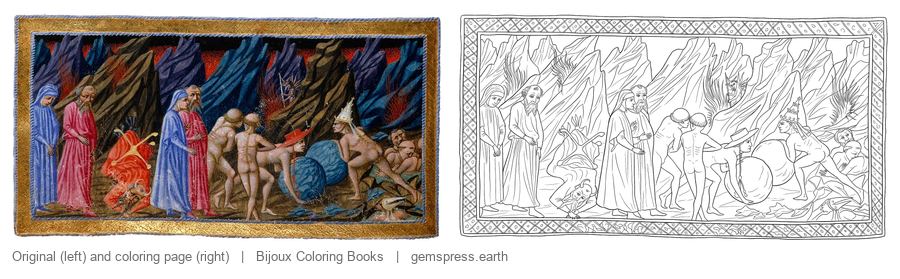
Dante’s Inferno: Dante and Virgil entering the fourth circle, with Plutus, the Prodigals and the Wrathful. Plutus, posted here as guardian, was a case of mistaken identity inherited from antiquity. Classical writers frequently confused Plutus, the Greek god of wealth, with Pluto, god of the underworld, and Dante’s version carries traces of both. In the painting, the souls of the greedy and the wasteful strain against enormous boulders.
Painted by Priamo della Quercia in Yates Thompson MS 36, a Sienese manuscript made around 1444-1450, now in the British Library.
The author has indicated this post may contain content not suitable for all audiences.
Get this book: Dante's Divine Comedy to Color →
Dante at the Tomb of Pope Anastasius
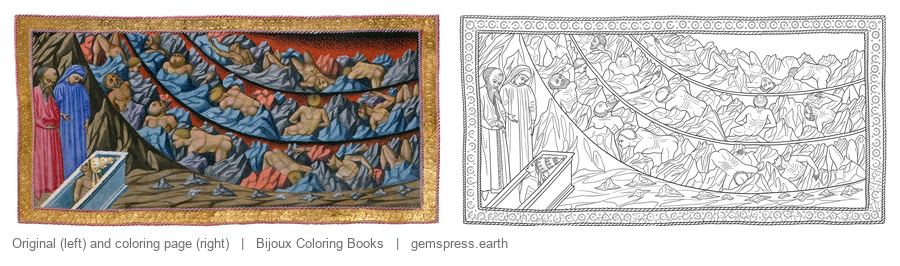
Dante’s Inferno: Dante and Virgil at the tomb of Pope Anastasius. In this scene, Virgil pauses to give a long lecture laying out how the rest of Hell is organized. It’s essentially a table of contents, planted halfway through the poem. Behind them, the painting lays out Hell’s lower circles in rows, packed with souls.
Painted by Priamo della Quercia in Yates Thompson MS 36, a Sienese manuscript made around 1444-1450, now in the British Library.
The author has indicated this post may contain content not suitable for all audiences.
Get this book: Dante's Divine Comedy to Color →
The Eighth Circle
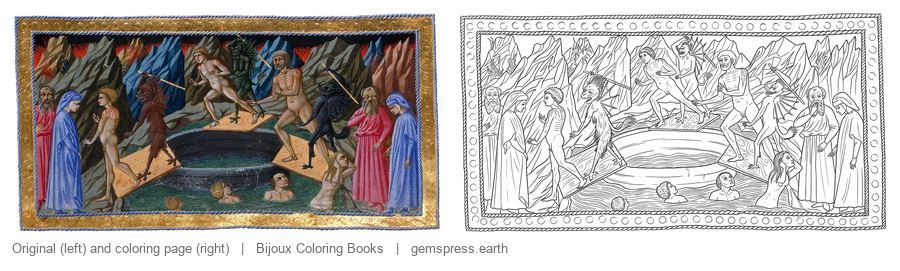
Dante’s Inferno: Virgil and Dante entering the eighth circle. This circle is the entrance to Malebolge, “the evil pouches”: ten concentric ditches holding the fraudulent, each one worse than the last. The structure is so elaborate that Dante scholars still draw diagrams of it today.
Painted by Priamo della Quercia in Yates Thompson MS 36, a Sienese manuscript made around 1444-1450, now in the British Library.
The author has indicated this post may contain content not suitable for all audiences.
Get this book: Dante's Divine Comedy to Color →
Dante Among the Counterfeiters
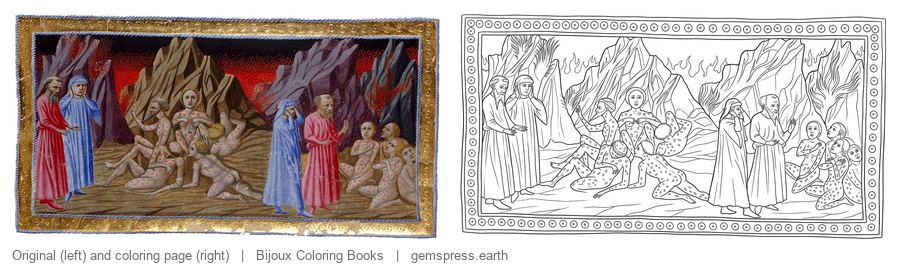
Dante’s Inferno: Dante and Virgil among the coiners and counterfeiters. Dante admits to being fascinated by a shouting match between two damned souls, and Virgil has to remind him that gawking at the spectacle is itself a small moral failing.
Painted by Priamo della Quercia in Yates Thompson MS 36, a Sienese manuscript made around 1444-1450, now in the British Library.
The author has indicated this post may contain content not suitable for all audiences.
Get this book: Dante's Divine Comedy to Color →
Dante at the Gates of Purgatory
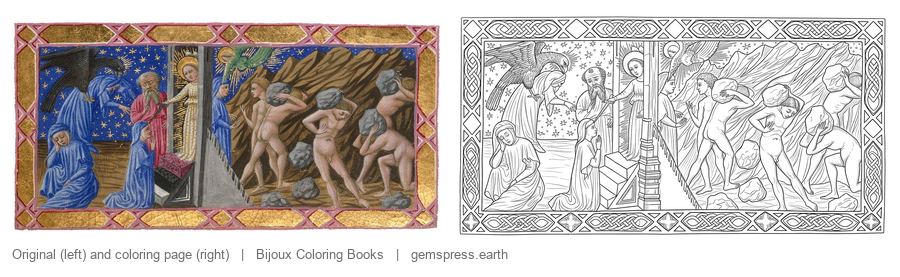
Dante’s Purgatorio: Dante and Virgil at the gates of Purgatory, with the Proud. Unlike Hell and Heaven, Purgatory actually changes over time. Its souls are all improving, unlike the fixed, eternal states of the realms above and below.
Painted by Priamo della Quercia in Yates Thompson MS 36, a Sienese manuscript made around 1444-1450, now in the British Library.
The author has indicated this post may contain content not suitable for all audiences.
Get this book: Dante's Divine Comedy to Color →
Dante and the Gluttons
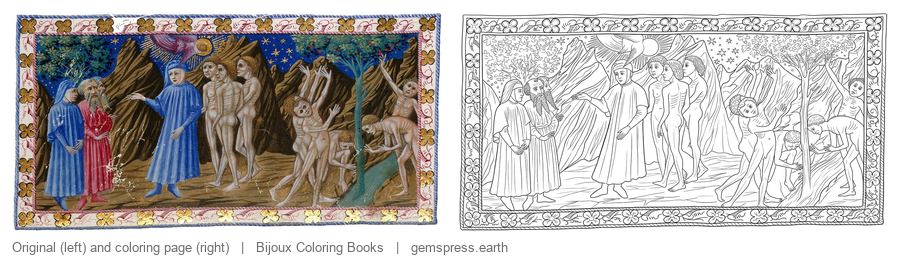
Dante’s Purgatorio: Forese Donati explaining the punishment of the Gluttons. Forese Donati was one of Dante’s real-life friends in Florence. In their youth, the two traded a series of playfully insulting sonnets. So Dante put his old friend in Purgatory, and then gave him a nice long speech.
Painted by Priamo della Quercia in Yates Thompson MS 36, a Sienese manuscript made around 1444-1450, now in the British Library.
The author has indicated this post may contain content not suitable for all audiences.
Get this book: Dante's Divine Comedy to Color →
Dante and the Wall of Flame
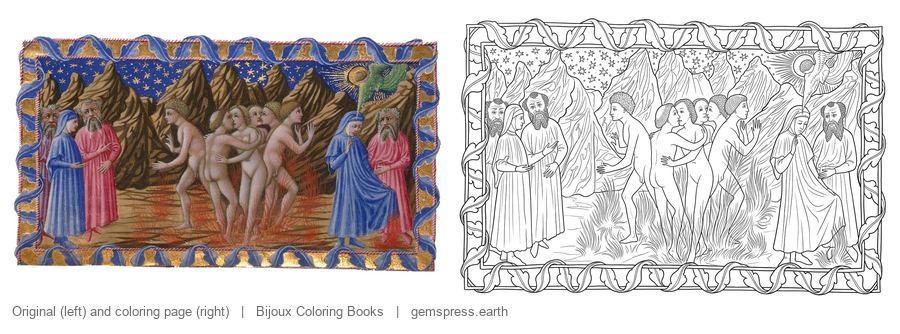
Dante’s Purgatorio: Dante and Virgil observing the fate of the Lustful. To reach the mountain’s summit, Dante has to walk straight through a wall of flame alongside the penitent Lustful. What finally gets him moving is Virgil’s promise that Beatrice is waiting on the other side.
Painted by Priamo della Quercia in Yates Thompson MS 36, a Sienese manuscript made around 1444-1450, now in the British Library.
The author has indicated this post may contain content not suitable for all audiences.
Get this book: Dante's Divine Comedy to Color →
Dante and Apollo
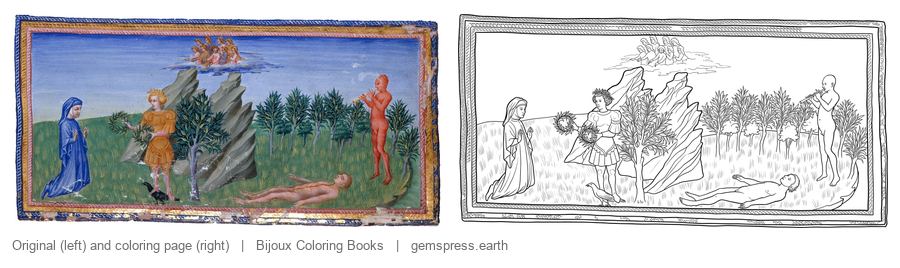
Dante’s Paradiso: Dante and Apollo before Parnassus. At the start of Paradiso, Dante calls on Apollo instead of the usual Muses, asking to be possessed by a god. Describing Heaven, he felt, was too vast a task for ordinary human inspiration.
Painted by Giovanni di Paolo in Yates Thompson MS 36, a Sienese manuscript made around 1444-1450, now in the British Library.
The author has indicated this post may contain content not suitable for all audiences.
Get this book: Dante's Divine Comedy to Color →
The Physics Lecture
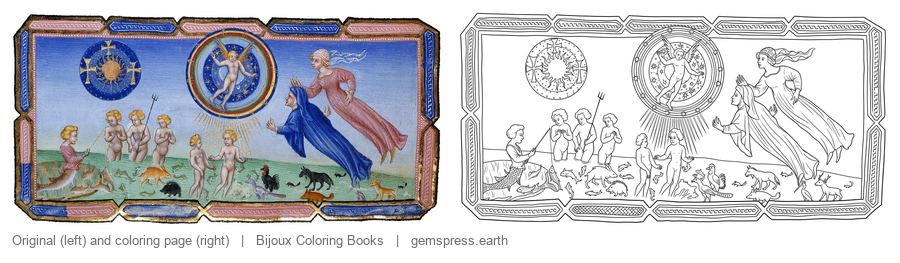
Dante’s Paradiso: Beatrice explaining the hierarchy of being. Dante is working from an Aristotelian, Earth-centered model of the universe, and this scene is essentially a physics lecture, delivered in mid-air.
Painted by Giovanni di Paolo in Yates Thompson MS 36, a Sienese manuscript made around 1444-1450, now in the British Library.
The author has indicated this post may contain content not suitable for all audiences.
Get this book: Dante's Divine Comedy to Color →
Beatrice and the Moon
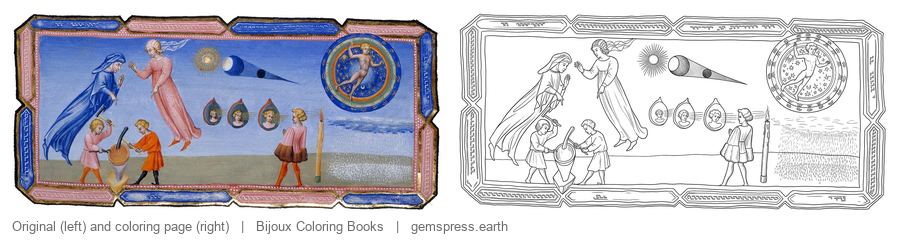
Dante’s Paradiso: Beatrice explaining the appearance of the moon. Beatrice corrects the scientific theory of the day, that the moon’s dark patches came from variations in its density. Her replacement explanation is also wrong by modern standards, but it’s more sophisticated than what most 14th-century natural philosophers believed.
Painted by Giovanni di Paolo in Yates Thompson MS 36, a Sienese manuscript made around 1444-1450, now in the British Library.
Get this book: Dante's Divine Comedy to Color →
The Resurrection of the Dead
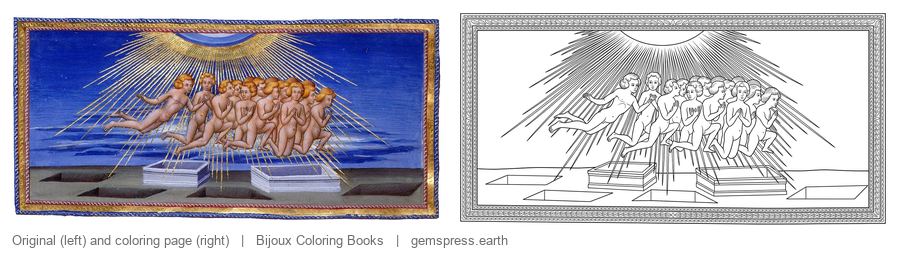
Dante’s Paradiso: the resurrection of the dead. Dante suggests that the blessed, radiant souls in Heaven long for the return of their physical bodies at the Last Judgment, because seeing their loved ones again in the flesh will make their joy even greater.
Painted by Giovanni di Paolo in Yates Thompson MS 36, a Sienese manuscript made around 1444-1450, now in the British Library.
The author has indicated this post may contain content not suitable for all audiences.
Get this book: Dante's Divine Comedy to Color →
The Heaven of Mars
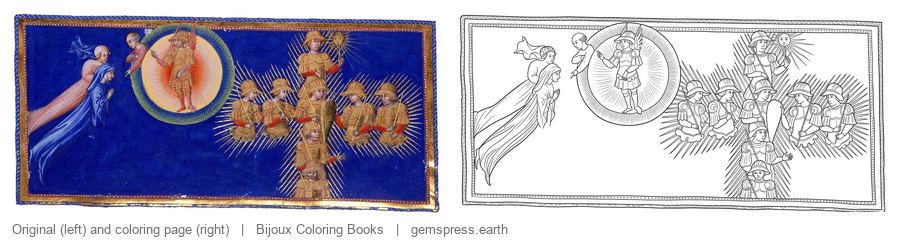
Dante’s Paradiso: Dante and Beatrice ascending to the Heaven of Mars, where Dante places the warriors of the faith, and it’s here that the poet meets his own great-great-grandfather, Cacciaguida, who died on Crusade.
Painted by Giovanni di Paolo in Yates Thompson MS 36, a Sienese manuscript made around 1444-1450, now in the British Library.
Get this book: Dante's Divine Comedy to Color →
The Eagle Made of Faces
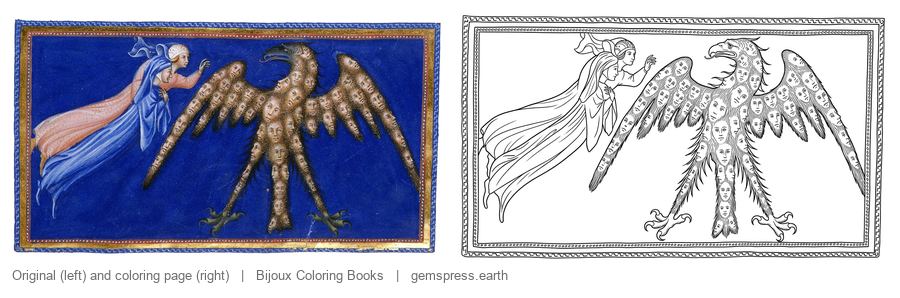
Dante’s Paradiso: Dante and Beatrice before the eagle of Justice. The eagle, formed from the souls of just rulers, speaks with a single collective voice made of many. It considers whether a virtuous person who never had the chance to hear of Christ can possibly be saved.
Painted by Giovanni di Paolo in Yates Thompson MS 36, a Sienese manuscript made around 1444-1450, now in the British Library.
Get this book: Dante's Divine Comedy to Color →
Five Just Princes
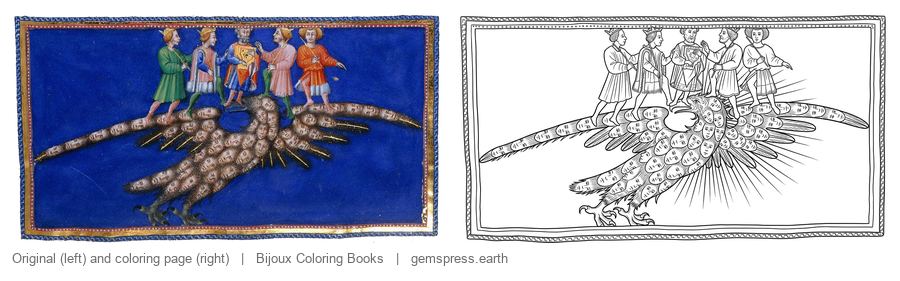
Dante’s Paradiso: five just princes atop the eagle of Justice. Among the five rulers singled out here, Dante includes the Trojan Ripheus, who appears for a single line in Virgil’s Aeneid, and controversially grants him salvation anyway, as proof that divine judgment can defy every human expectation.
Painted by Giovanni di Paolo in Yates Thompson MS 36, a Sienese manuscript made around 1444-1450, now in the British Library.
Get this book: Dante's Divine Comedy to Color →
Why Beatrice Stopped Smiling
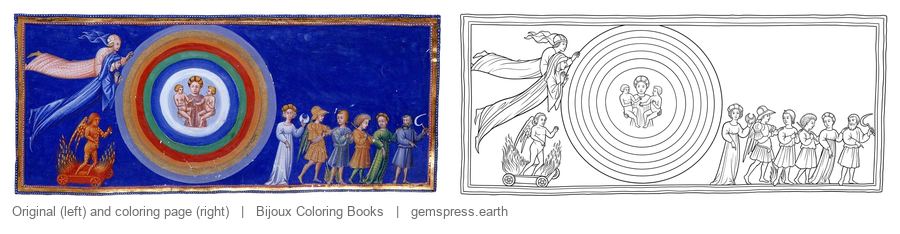
Dante’s Paradiso: Dante and Beatrice before the Seven Spheres of Man. By this point in the ascent, Dante notices that Beatrice has stopped smiling at him. She explains that her beauty is now so intensified by their nearness to God that a direct smile might overwhelm his still-mortal senses.
Painted by Giovanni di Paolo in Yates Thompson MS 36, a Sienese manuscript made around 1444-1450, now in the British Library.
Get this book: Dante's Divine Comedy to Color →
Dante and Beatrice Before the Light
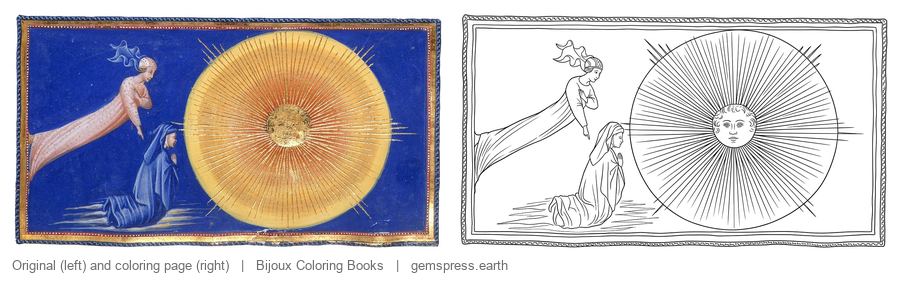
Dante’s Paradiso: Dante and Beatrice before the Light. The poem’s very last word, in the original Italian, is stelle: “stars.” It’s the same word that closes Inferno and Purgatorio too. Dante ends all three books on the same hopeful note.
Painted by Giovanni di Paolo in Yates Thompson MS 36, a Sienese manuscript made around 1444-1450, now in the British Library.
Get this book: Dante's Divine Comedy to Color →
Want to try before you buy? Print free sample pages at gemspress.earth/free-coloring-pages.